Production data for controlled model improvement
AWS published a reproducible walkthrough that captures inference, detects distribution change, builds training data, and evaluates a new version. This guide separates that mechanism from a governed enterprise loop with minimization, consent, labeling, holdouts, and rollback.
- Published
- min read
- 6 min read
- Categoría
- AI Systems
On this page
6 chapters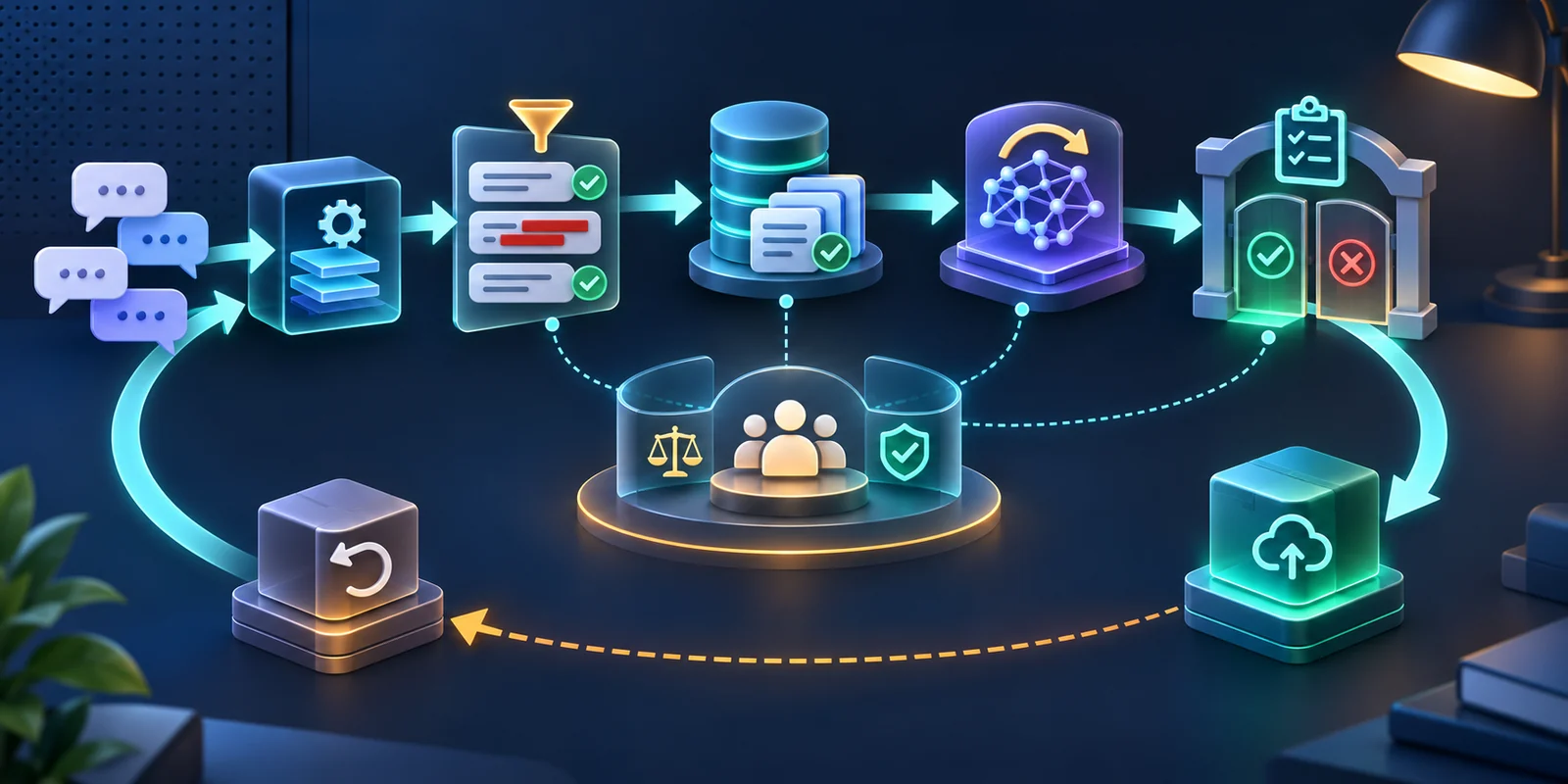
Chapter 01
How do you turn real traffic into model improvement?
A useful loop captures only authorized signals, finds repeatable failures, produces reviewable examples, and deploys a new version only after it passes an independent evaluation set.
On November 13, 2026, one America/Lima calendar day before this publication, AWS published a complete improvement walkthrough using SageMaker HyperPod Data Capture. The example records requests and responses from a support router, queries the records with Athena, detects a new product category, applies a SQL labeling policy, fine-tunes the model, and compares the resulting version against a separate set. Capture itself did not launch yesterday: AWS announced it on May 20. The relevant November development is the reproducible example, scripts, and measurements, not a new feature or proof of universal results.
The CTO decision is not whether to save every prompt. It is whether a verifiable chain exists from an authorized interaction to a model change: purpose, minimization, access, redaction, label, provenance, evaluation, approval, and reversal. If any link is missing, the supposed flywheel can turn personal data into a permanent dataset, learn the wrong rule with high confidence, or improve a visible case while silently degrading other segments. Capture is observability. Training is an intervention. Production requires governing the transition between them.
Chapter 02
Which layer should you capture, and why?
HyperPod provides three independent points. The SageMaker endpoint captures full payloads and integrates with Model Monitor; the load balancer records traffic metadata, status codes, timings, IP, and user agent; the model pod captures payloads and event metadata close to the container, with sampling, buffering, payload limits, and KMS encryption. Enabling everything does not mean better observability: tiers 1 and 3 can duplicate the same sensitive content. Choose the layer based on the operational question and retain the minimum. Availability and latency may need metadata only; quality analysis needs content, but also stricter controls.
The technical path also creates invisible failures. In the example, calls that bypass the pod proxy are not captured; a Mountpoint-S3 identity without permissions can leave the endpoint healthy while no records arrive; and files are written in batches, so temporary absence does not prove loss. Instrument three separate counts: requests served, requests selected by sampling, and records confirmed in storage. Alert on the expected difference, not only on HTTP 200. Version capture configuration, schema, and retention policy alongside the model release.
| Layer | Useful signal | Primary risk |
|---|---|---|
| Endpoint | Payload and Model Monitor | Duplicating sensitive content |
| Load balancer | Traffic, errors, and timings | Cannot explain semantic quality |
| Model pod | Debugging and potential dataset | PII, access, and proxy bypass |
Chapter 03
Six gates before training on production data
Gate 1, purpose and consent: define which interactions may support quality, evaluation, or training, and honor exclusions by user, tenant, contract, and jurisdiction. Gate 2, minimization: capture only required fields, redact secrets and personal data before the dataset, and apply short retention to raw records. Gate 3, isolation: separate storage by environment and product, encrypt with controlled keys, restrict readers, and audit access. An encrypted bucket does not fix an invalid purpose or prevent an analyst from exporting improper content.
Gate 4, labeling: turn incidents into reviewable rules and preserve annotator disagreement; never treat the model's self-reported confidence as truth. In the AWS example, 10 of 14 observed errors reported confidence of 0.9 or higher, a clear sign that the generated number was not calibrated. Gate 5, evaluation: freeze a content-level holdout, then add regressions for existing classes plus privacy, security, and format slices. Gate 6, release: compare challenger and active versions, require approval for material changes, deploy gradually, and preserve the artifact, configuration, and rollback path.
- Never promote a raw record directly into training.
- Separate diagnostic data, training data, and evaluation sets.
- Record source, transformation, label, reviewer, and version for every example.
- Maintain a deletion path that reaches derivatives and future rebuilds.
Chapter 04
Hypothetical example: a claims classifier
Imagine an insurer adding coverage for electric-vehicle batteries. Its historical classifier routes those claims to general electrical damage. The team captures an authorized sample with identifiers, policy numbers, plates, and free text redacted; a query detects the new pattern; specialists define the taxonomy and review ambiguous cases. The label does not come from a keyword such as battery: it combines vehicle type, affected component, and covered event. Disagreements remain review cases rather than forced answers.
The team trains a challenger and evaluates it on new claims that never entered training. It measures recall for the new coverage, precision across prior classes, abstention rate, high-severity errors, and stability by channel and language. It also verifies that redaction did not remove required signal and that no example contains prohibited data. Only then does it route a small traffic share, compare decisions with the active version, and retain human review for payouts or denials. The model classifies; the transaction system keeps rules, authorization, and auditability.
Chapter 05
How do you evaluate the flywheel, not just the model?
AWS reports that in its synthetic environment the router moved from 235 to 280 correct predictions on 280 generated tickets and from 16 to 20 correct predictions on 24 hand-written probes. Those results describe one run using Qwen2.5-3B-Instruct, synthetic data, and a limited taxonomy; they are not a HyperPod benchmark or a promise for enterprise traffic. The important contrast is that manual probes exposed shortcuts the generated set missed: terms associated with the new product also appeared in inventory and price questions. A holdout created by the same generator can validate its own bias.
Evaluate the system at four levels. Pipeline: capture coverage, delay, duplicates, decoding failures, and redaction effectiveness. Data: distribution, provenance, agreement, split contamination, and deletion requests. Model: quality by slice, calibration, abstention, safety, and regressions. Operations: cost per approved example, review time, inference latency, incidents, and rollback. In the published test, the latency difference between the direct and proxy paths stayed within observed variation on that hardware; validate again with your payloads, concurrency, network, and sidecars.
Chapter 06
Limits and the implementation decision
Do not adopt this pattern if you cannot establish a legal or contractual basis for reusing interactions, isolate tenants, delete derivatives, or fund human review. Do not use it for ungated continuous learning either: user behavior changes in response to the model, attackers can seed examples, and one repeated bad answer can look frequent and therefore important. Production data is biased by the product, routing, current customers, and what the system already chose to show. It is operational evidence, not a neutral sample of the world.
Start with a diagnostic-only loop: limited capture, redaction, queries, and a failure backlog without training anything. If the team demonstrates coverage, traceability, and deletion, add a curated dataset and offline evaluation. Automate reproducible transformations later, not final approval. The opportunity in the AWS publication is that the technical pieces can now be connected end to end. Enterprise value appears when that circuit preserves consent, evaluation independence, and reversibility. If you need to design that pilot around your data and constraints, Wasyra's custom service can turn the flow into architecture, controls, and verifiable gates; it is separate from the Agents product at agents.wasyra.com.
Written by
Wasyra Lab
AI systems and operations architecture
Wasyra Lab publishes practical frameworks for designing AI agents, automations, and operating flows that survive production.
Series
AI systems that actually reach production
A series on agents, copilots, and guardrails for bringing AI into real work without breaking trust or operations.
Posts in this seriesMore from this author
More from this author
AI Systems
Agent hooks: 7 tests before tools execute
AgentCore's new lifecycle hooks expose four control boundaries. This guide turns them into seven tests for authorization, failure, and auditability.
ArticleAI Systems
Scientific post-training: 7 evidence gates
Nemotron for Science opens scientific post-training. These seven gates prevent proxy optimization, test leakage, and false improvements.
ArticleKeep reading
Keep reading
AI Systems
Agent hooks: 7 tests before tools execute
AgentCore's new lifecycle hooks expose four control boundaries. This guide turns them into seven tests for authorization, failure, and auditability.
ArticleAI Systems
Scientific post-training: 7 evidence gates
Nemotron for Science opens scientific post-training. These seven gates prevent proxy optimization, test leakage, and false improvements.
ArticleAI Systems
Agentic RL: how to read MLPerf Training 6.1
MLPerf now measures agent post-training. Learn how to read time to quality, workload limits, and useful infrastructure decision signals.
Article