AI models: contracts that catch regressions
Hugging Face proposes integration contracts that run real usage paths on reduced models on CPU and catch silent changes before main. This guide turns the idea into an adoption decision covering coverage, provenance, tolerances, review, and escalation.
- Published
- min read
- 6 min read
- Categoría
- Engineering
On this page
6 chapters- 01What changes with a model integration contract?
- 02How does it work without loading the full checkpoint?
- 03Hypothetical example: changing the attention backend
- 04Six gates before blocking merges
- 05Limits: the fixture can pass while the real model fails
- 06The decision: buy an earlier signal, not a total guarantee
Chapter 01
What changes with a model integration contract?
The contract moves a representative model path from late validation into the pull request.
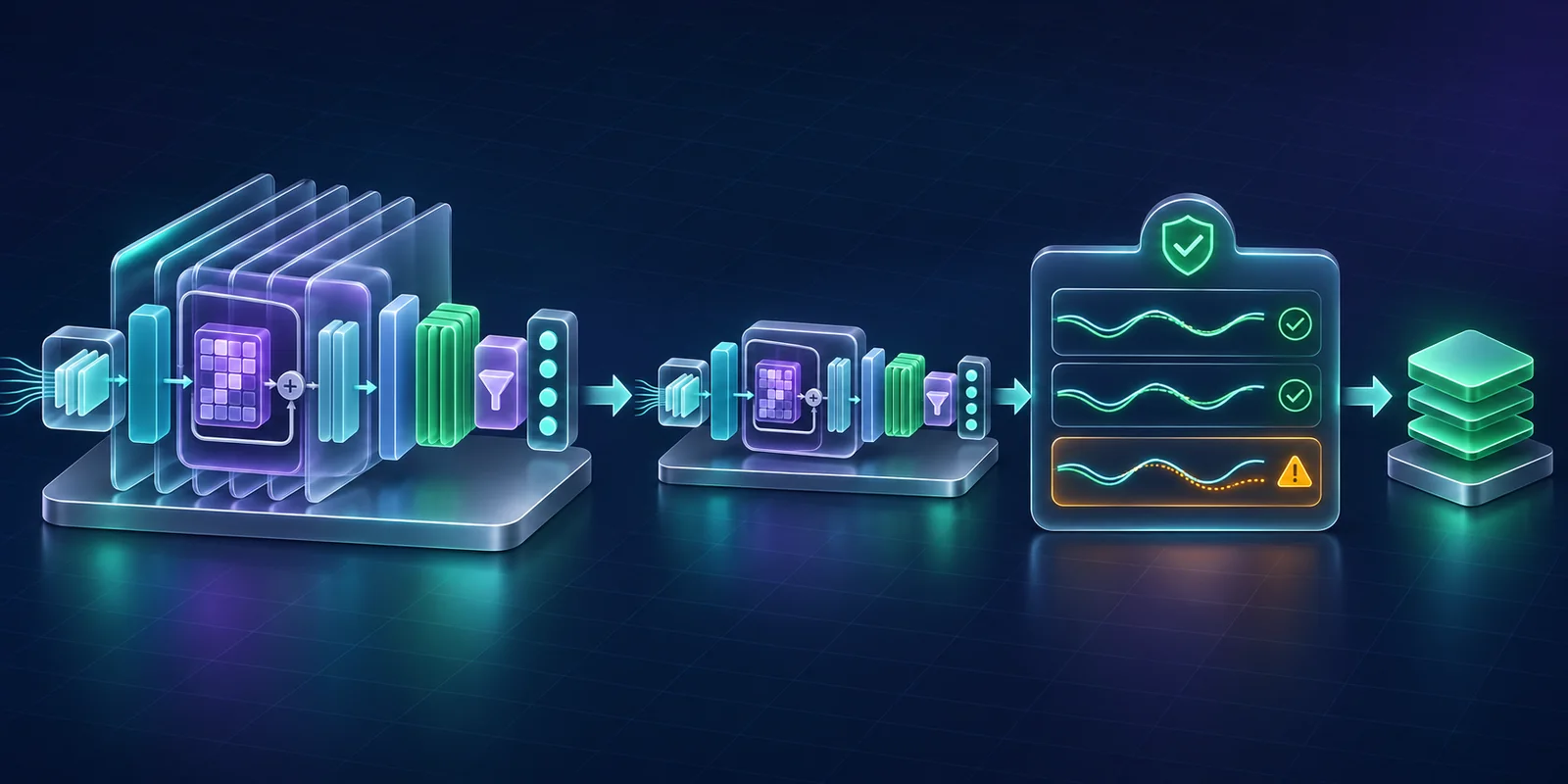
On November 3, 2026, one America/Lima calendar day before this publication, Hugging Face introduced Model Integration Contracts, a proposal for testing Transformers architectures with three versioned pieces: a pinned reduced fixture, an executable usage path, and human-reviewed baselines. The useful decision for a CTO is not to replace the full suite with small models. It is to add a fast CI signal that traverses the same tokenizer, weight format, attention variant, and call that teams use, then compares outputs, loss, gradients, and parameter updates with approved expectations. That design can detect a regression that never crashes and that a generic forward pass misses. But a contract covers only the architecture, environment, inputs, and path it declares. It must coexist with real-checkpoint tests, hardware validation, quality evaluation, and production observability.
The proposal arrives with concrete evidence and published limits. The project replayed frozen contracts across months of commits and reproduced a UMT5 regression in which the decoder could attend to future tokens under SDPA. The selected contract failed with the same deltas when the fix was reverted inside Transformers CI. Even so, the team keeps the job informational: as of November 1 it reported failures without blocking PRs because real-PR bug catches, false positives, and review cost still need measurement. That separation between a technical demonstration and merge policy is the announcement's most valuable lesson.
Chapter 02
How does it work without loading the full checkpoint?
The fixture starts from a real checkpoint configuration and reduces width and depth while preserving layer classes that change behavior. A hybrid model cannot keep two convenient layers if doing so removes full attention, a MoE layer, or a shared KV-cache path. The builder compares the types constructed by the original and reduced configurations, preserves processors and special tokens without rewriting them, keeps the format that exercises load conversions, and publishes the weights once. CI consumes a pinned revision; it does not rebuild the fixture on every run because different hardware can produce different bytes.
The usage path turns that artifact into a contract. It can generate deterministically, run a training step, verify finite gradients, and confirm that the optimizer changes weights. It then compares results with approved baselines for a platform class and dtype. Selection maps changed files to contracts: a model change runs its family, while a shared utility may activate several. The goal is not to make every test cheaper; it is to move the highest-signal path that fits a frequent runner earlier.
| Layer | Primary signal | Remaining gap |
|---|---|---|
| Unit test | Isolated function or shape | May miss real configuration and processor behavior |
| Reduced contract | Real path and pinned expectations | Does not represent all learned capability |
| Real checkpoint | Real weights, quality, and memory | Cost and hardware-limited coverage |
| Production canary | Real traffic, dependencies, and SLOs | Detects after deployment |
Chapter 03
Hypothetical example: changing the attention backend
Imagine, hypothetically, that a company serves an encoder-decoder to summarize case files and wants to enable a more efficient attention kernel. Unit tests validate dimensions and the smoke test returns text, but neither asks whether the decoder can see future information during training. The team creates a reduced fixture that preserves the default attention variant and real tokenizer. Its path runs deterministic inference and a training batch with shifted labels, recording generated IDs, label log-probabilities, loss, gradients, and the weight change after one step.
The PR changes backend selection, so the contract runs on CPU and finds a loss divergence without an exception. That does not prove the new kernel is wrong: the difference may come from precision, platform, or a stale baseline. The merge pauses while the owner reproduces with the real checkpoint on target hardware, compares the eager path, and reviews whether the change alters accepted semantics. If the change is intentional, the baseline is updated in a separate PR with evidence; if it is not, the contract preserves a minimal case for the fix. This example describes a decision flow, not a measured Wasyra result.
Chapter 04
Six gates before blocking merges
Start in shadow mode and require evidence for every severity promotion.
Gate one, scope: every contract names its architecture, calls, inputs, backend, platform, and dtype. Gate two, fidelity: the fixture preserves the processors, formats, and layer types that exercise the user path. Gate three, provenance: source checkpoint, fixture revision, dependencies, baseline, and contract selector are pinned by digest. Gate four, sensitivity: input perturbations and seeded faults demonstrate that assertions can see the problem they claim to cover. Gate five, stability: the team measures allowed drift across runners and separates tolerances by platform without widening them to hide changes. Gate six, operations: owners, time budget, escalation, and the mechanism for approving new expectations are defined before a warning becomes blocking.
For four to six weeks, record how many PRs select contracts, setup and execution time, repeatable failures, confirmed regressions, false alarms, and human minutes to classification. A promotion rule can require several real regressions and an acceptable noise rate before blocking. It also needs a controlled escape: if the contract fails because of infrastructure, the PR must not be approved as if it passed; it should remain unevaluated with a retry and owner. An emergency bypass must expire and open follow-up work, not automatically rerecord expectations.
- Explicit scope and an auditable changed-file selector.
- Pinned fixture that preserves the relevant path.
- Reviewed baselines by platform and precision.
- Sensitivity tested with representative perturbations.
- Shadow mode with signal and noise classification.
- Separate blocking, bypass, and update policy.
Chapter 05
Limits: the fixture can pass while the real model fails
Reducing an architecture always discards something. Random weights may respond to inputs while producing useless generations; overfit weights improve readability and sensitivity in some cases but add convergence and maintenance. The project's study found Whisper paths that failed only with real weights. It also showed that the same numeric baseline must not be assumed across CPU, GPU, dtype, or different kernels. A green contract means reviewed expectations held for that combination; it does not certify language quality, safety, throughput, memory, or compatibility with every checkpoint.
The organizational risk is turning golden outputs into a ritual. If every difference is accepted by rerecording baselines, the contract loses power. If every difference blocks, teams learn to avoid it. Review must compare intent, diff, reproduction, and effect on the real checkpoint. Contracts also do not replace product data: an identical output can still be wrong for users, while a numerically different output may be an intentional improvement. Keep integration compatibility, model quality, and business outcomes separate.
Chapter 06
The decision: buy an earlier signal, not a total guarantee
Adopt a reduced contract when a critical architecture has an expensive path that currently runs only overnight, a plausible silent regression, and an expectation stable enough to review. Start with one or two paths: the default attention variant, the processor customers use, and a training or generation step that has failed before. Keep the real checkpoint in a later layer and measure whether the new signal changes merge decisions. If the fixture does not preserve the mechanism or its failures cannot be classified, it is not ready to block.
Model Integration Contracts offers a disciplined way to move evidence into the PR without pretending a tiny model is production. Its value depends less on fixture size than on path fidelity, expectation provenance, and the human policy that responds to a difference. If you need to design an evaluation pipeline for models or agents with reproducible gates, Wasyra can help define the contract, automate the evidence, and connect it to a verifiable operating decision.
Written by
Wasyra Lab
AI systems and operations architecture
Wasyra Lab publishes practical frameworks for designing AI agents, automations, and operating flows that survive production.
Series
AI systems that actually reach production
A series on agents, copilots, and guardrails for bringing AI into real work without breaking trust or operations.
Posts in this seriesMore from this author
More from this author
AI Systems
AI agent containment: eight gates beyond a sandbox
A container is not enough for agent execution. Eight gates cover isolation, secrets, egress, identity, monitoring, and safe stops.
ArticleAI Systems
Decisions API: seven gates for production
Decisions API speeds up bounded answers. Seven gates help calibrate thresholds, fallbacks, and review before automation.
ArticleKeep reading
Keep reading
Engineering
AI data centers: design flexible demand
Flexible demand requires more than turning off GPUs: contracts, scheduling, recovery, telemetry, and costs must be tested together.
ArticleEngineering
Kubernetes inference: validate the full runtime
A healthy endpoint does not prove the platform. Seven gates validate compatibility, scheduling, routing, observability, and rollback.
ArticleEngineering
Formal verification with AI: seven gates for trusting a proof
A formal proof does not make an entire system infallible. Seven gates separate a verifiable guarantee from an overbroad claim.
Article