Kubernetes inference: validate the full runtime
NVIDIA's new workflow for running Dynamo with AICR recipes shows why model serving is a systems problem. This guide turns that idea into a reproducible acceptance contract for teams operating inference on Kubernetes.
- Published
- min read
- 7 min read
- Categoría
- Engineering
On this page
7 chapters- 01What changes when you validate the full inference runtime?
- 02The mechanism: snapshot, recipe, bundle, and evidence
- 03Hypothetical example: a B2B agent with long prefixes
- 04Which seven gates must the runtime pass?
- 05How do you evaluate without turning the pilot into production?
- 06Limits and risks the recipe does not remove
- 07The decision: buy an evidence chain
Chapter 01
What changes when you validate the full inference runtime?
The criterion moves from “the pod started” to “this exact infrastructure combination can receive traffic under a verifiable contract.”
On October 30, 2026, two calendar days before this publication in America/Lima, NVIDIA published a workflow for deploying and validating Dynamo on Kubernetes with AI Cluster Runtime (AICR). The news is not a model benchmark: it is a way to treat drivers, GPU discovery and allocation, scheduling, workload coordination, metrics, and ingress as one versioned dependency. The described recipe pins components and expectations, then compares the real cluster with configuration and behavioral checks before the application is installed. For a CTO, the concrete decision is to separate three approvals: the recipe is compatible with the captured environment, the deployed runtime satisfies its checks, and the endpoint meets the product's SLO and quality bar. None replaces the others. An HTTP 200 proves only that a path responded; it does not confirm that the workload can be rescheduled, a degraded GPU stays out, the router sees actual cache state, or metrics can diagnose a regression.
The official article shows a Dynamo inference recipe that includes the platform chart pinned to version 1.4.2 and dependencies such as GPU Operator, Dynamic Resource Allocation, KAI Scheduler, Grove, Prometheus, and an optional Gateway API path. That list should not be copied as a universal architecture. Its value is exposing the hidden contract beneath the model server and turning it into artifacts that can be reviewed, reproduced, and revalidated.
Chapter 02
The mechanism: snapshot, recipe, bundle, and evidence
The flow begins by capturing a normalized cluster snapshot. That artifact describes the Kubernetes distribution, accelerators, operating system, and topology signals the resolver can observe. Workload intent—for example, inference with Dynamo—is supplied explicitly. From both inputs, AICR selects a recipe that pins versions, compatibility, placement, checksums, and validation expectations. It then renders a bundle for the selected deployment tool. The separation matters: the snapshot describes what exists, the recipe declares what should exist, and the bundle expresses how to materialize it.
Offline validation against another snapshot can detect declarative constraints before touching a cluster, but it skips behavioral checks. Live validation must check resources, accelerator access, operator health, scheduling, scaling, observability, and ingress. The application then installs its own inference graph and runs endpoint tests. This order prevents a platform failure from being confused with a model failure. It also leaves an auditable chain: snapshot, recipe, bundle, validation report, application manifest, and acceptance result.
Provenance is part of the mechanism, not decoration. The AICR repository describes versioned recipes, release artifacts, SBOMs, and verifiable attestations. Even so, a signature proves origin and integrity within its scope; it does not show that the runtime is safe under every network policy or that the application meets its quality bar. The consumer must record exactly which identity signed, which hashes are covered, and which report phases were executed or skipped.
Chapter 03
Hypothetical example: a B2B agent with long prefixes
Imagine a hypothetical platform serving an agent for B2B operations. Each session reuses a long system prompt, tool definitions, and retrieved context. The team wants KV-cache-aware routing to reduce reprocessing, but it also needs workers to reschedule when a node fails. The pilot declares two paths: Dynamo's own frontend for a dedicated endpoint and a future Gateway API option for shared ingress. It does not begin by trying to prove which one is faster; it first pins who selects the worker, who applies timeouts and retries, and who owns the state that drives that selection.
The recipe deploys the compatible foundation and the report confirms its checks. A bounded chaos test then drains a node, a routing test repeats known prefixes, and an observability test requires correlation across request, worker, cache, latency, and error. Application acceptance uses synthetic conversations and approved business cases to measure correct responses, safe stops, and cost per accepted task. If the runtime passes but the model fails quality, the cluster is not changed to hide it. If quality passes but the scheduler cannot recover capacity, the release is not promoted either. Both signals reach the same release gate while retaining separate owners and diagnostics.
Chapter 04
Which seven gates must the runtime pass?
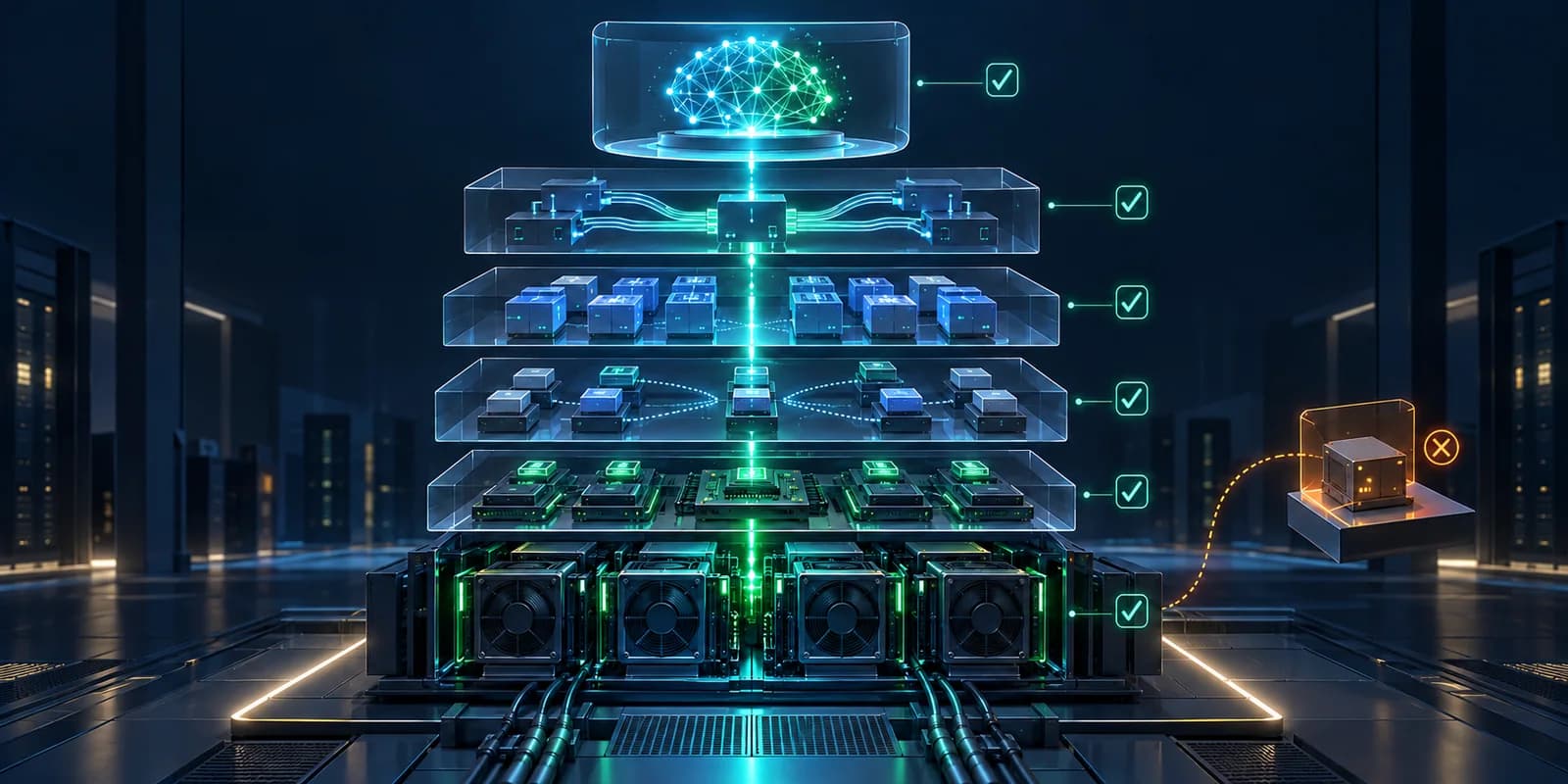
Each gate produces its own evidence and fails closed. A partial result can support diagnosis, but it cannot authorize production traffic.
First, inventory: capture cloud, Kubernetes version, operating system, GPU, topology, storage, and networking without filling gaps by intuition. Second, compatibility: resolve an explicit recipe for that environment and intent; if no supported match exists, the result is unsupported, not “almost compatible.” Third, provenance: verify the binary, charts, images, SBOM, signatures, and hashes before deployment. Fourth, materialization: confirm that the applied bundle matches the reviewed recipe and that no out-of-contract overrides appeared.
Fifth, conformance: run live checks for GPUs, operators, scheduling, scaling, metrics, and ingress, and retain every skipped step. Sixth, traffic behavior: demonstrate worker selection, retry bounds, timeout handling, recovery, and cache signals with representative loads. Seventh, acceptance and rollback: measure the product's SLO, quality, cost, and operations; set thresholds before the trial and preserve a reversal path that includes compatible manifests, images, and data. Promotion happens only when all seven evidence sets point to the same candidate artifact.
| Gate | Evidence | Failure it prevents |
|---|---|---|
| 1. Inventory | Cluster snapshot | Environment assumptions |
| 2. Compatibility | Resolved recipe | Unsupported combination |
| 3. Provenance | Signatures, SBOM, and hashes | Substituted artifact |
| 4. Materialization | Bundle and applied state | Deployment drift |
| 5. Conformance | Live-check report | Present but broken component |
| 6. Traffic | Routing and recovery tests | Healthy endpoint on a fragile path |
| 7. Acceptance | SLO, quality, and rollback | Green infrastructure, failed product |
Chapter 05
How do you evaluate without turning the pilot into production?
Start with an isolated cluster or pool that represents the target combination. Save the snapshot and resolve the recipe without improvised overrides. Run declarative validation first, review skipped checks, and only then materialize the bundle. Live validation should produce a machine-readable report and a human-readable diff. Next, install one inference workload, not the full portfolio. Verify startup, readiness, GPU allocation, placement, draining, autoscaling within the supported scope, metrics, and ingress. Every skip remains an open risk with an owner and date, not a pass.
The traffic phase uses two suites. The first tests the platform with deterministic requests, induced failures, and known bounds; it asks whether the runtime routes and recovers according to contract. The second tests the product with representative prompts, tools, and distributions; it asks whether tasks are accepted at sufficient quality, latency, and cost. Record the recipe version, images, model, server, routing configuration, dataset, and observation window. Without that composite identity, an improvement cannot be reproduced and a rollback may restore only half the platform.
Chapter 06
Limits and risks the recipe does not remove
A validated combination ages. A security patch, driver change, CRD change, or Kubernetes upgrade can break compatibility, while pinning everything forever can retain vulnerabilities. The answer is neither blind upgrades nor permanent freezes: generate a new candidate, preserve the previous one, and rerun the affected gates. Dynamo documentation also warns that AICR validation does not replace direct component checks and that, after a platform version change, each deployment's runtime images must remain aligned.
Coverage also has boundaries. A recipe may support a specific cloud, GPU, and operating system but not another company's exact topology. An attestation can be valid yet correspond to a different cluster. Available Prometheus does not mean useful alerts; a healthy scheduler does not guarantee fairness; cache-aware routing does not guarantee lower cost for your session mix. Name each inference as a hypothesis and measure it locally. Vendor evidence reduces the space of uncertainty, but final acceptance belongs to the operator.
Chapter 07
The decision: buy an evidence chain
Adopt a validated recipe when the cost of manually integrating and checking the stack exceeds the value of customizing every layer, and when explicit coverage exists for your environment. Keep a smaller platform if a model server, scheduler, and basic observability satisfy the workload; adding components merely to look enterprise expands the failure surface. In either case, define the same contract: inventory, compatibility, provenance, materialization, conformance, traffic, and product acceptance.
The contribution of the October 30 workflow is not a promise of incident-free Kubernetes. It shows that an inference endpoint belongs to a versioned chain that can be inspected and retested. That shift improves the buying conversation: instead of asking “does the model run?”, ask “which combination was validated, against which actual state, with which checks, what was skipped, and how do we go back?” If you need to design that contract around a specific agent or product, Wasyra's custom service can turn the stack, evaluations, and operations into a pilot with explicit acceptance criteria.
Written by
Wasyra Engineering
Modernization, architecture, and reliable delivery
Wasyra Engineering documents patterns for moving legacy systems without freezing delivery or breaking ownership.
Series
AI systems that actually reach production
A series on agents, copilots, and guardrails for bringing AI into real work without breaking trust or operations.
Posts in this seriesMore from this author
More from this author
Engineering
Formal verification with AI: seven gates for trusting a proof
A formal proof does not make an entire system infallible. Seven gates separate a verifiable guarantee from an overbroad claim.
ArticleEngineering
AI legacy migration: seven parity gates
A high benchmark score does not authorize a legacy migration. Seven gates turn code translation into evidence of parity and rollback.
ArticleKeep reading
Keep reading
Engineering
Formal verification with AI: seven gates for trusting a proof
A formal proof does not make an entire system infallible. Seven gates separate a verifiable guarantee from an overbroad claim.
ArticleEngineering
AI legacy migration: seven parity gates
A high benchmark score does not authorize a legacy migration. Seven gates turn code translation into evidence of parity and rollback.
ArticleEngineering
Local AI for coding agents: five boundaries you need to measure
Running the model on device does not make the whole agent offline or secure. These five boundaries turn the local promise into a verifiable decision.
Article