Agentic RL: how to read MLPerf Training 6.1
MLPerf Training 6.1 introduces a GRPO post-training workload for software agents. This guide separates what the result demonstrates from what a company must still measure in its own product, data, and operations.
- Published
- min read
- 6 min read
- Categoría
- AI Systems
On this page
7 chapters- 01How should you read the MLPerf agentic RL benchmark?
- 02What mechanism sits behind time to quality?
- 03What does the result prove, and what remains outside it?
- 04Hypothetical example: decide whether to train, rent, or wait
- 05Six questions for an infrastructure decision
- 06How do you evaluate without training to the scoreboard?
- 07The decision: buy evidence, not only accelerators
Chapter 01
How should you read the MLPerf agentic RL benchmark?
Read it as a full-system test for reaching fixed quality, not as a universal agent ranking.
MLPerf Training 6.1 makes it possible to compare how long a full system takes to bring a fixed model to a fixed quality threshold through reinforcement-learning post-training. The workload uses Qwen3.5-397B-A17B, Group Relative Policy Optimization, software-repair tasks, a sandboxed CodeAct agent, and a pass@4 target. The published number combines trajectory generation, tool execution, reward verification, weight updates, and intermediate evaluations, so it is useful for studying coordination across accelerators, memory, networking, storage, and execution environments. It does not prove that the fastest system produces the best agent for your repository, has the lowest total cost, is safe, or generalizes to another domain. For an enterprise decision, treat the result as evidence of capability and efficiency under a reproducible contract, then require your own trial with your tasks, policies, success rate, cost, failures, and operating constraints.
MLCommons published the results on November 16, 2026, one America/Lima calendar day before this article. The development is not merely another large model: it is the addition of a standardized agentic post-training workload to a peer-reviewed suite. MLCommons reported 153 systems and 250 results across the whole round; those counts describe participation in the entire suite, not 153 comparable runs of the agentic RL workload. Keeping that distinction prevents a coverage announcement from becoming an unsupported performance conclusion.
Chapter 02
What mechanism sits behind time to quality?
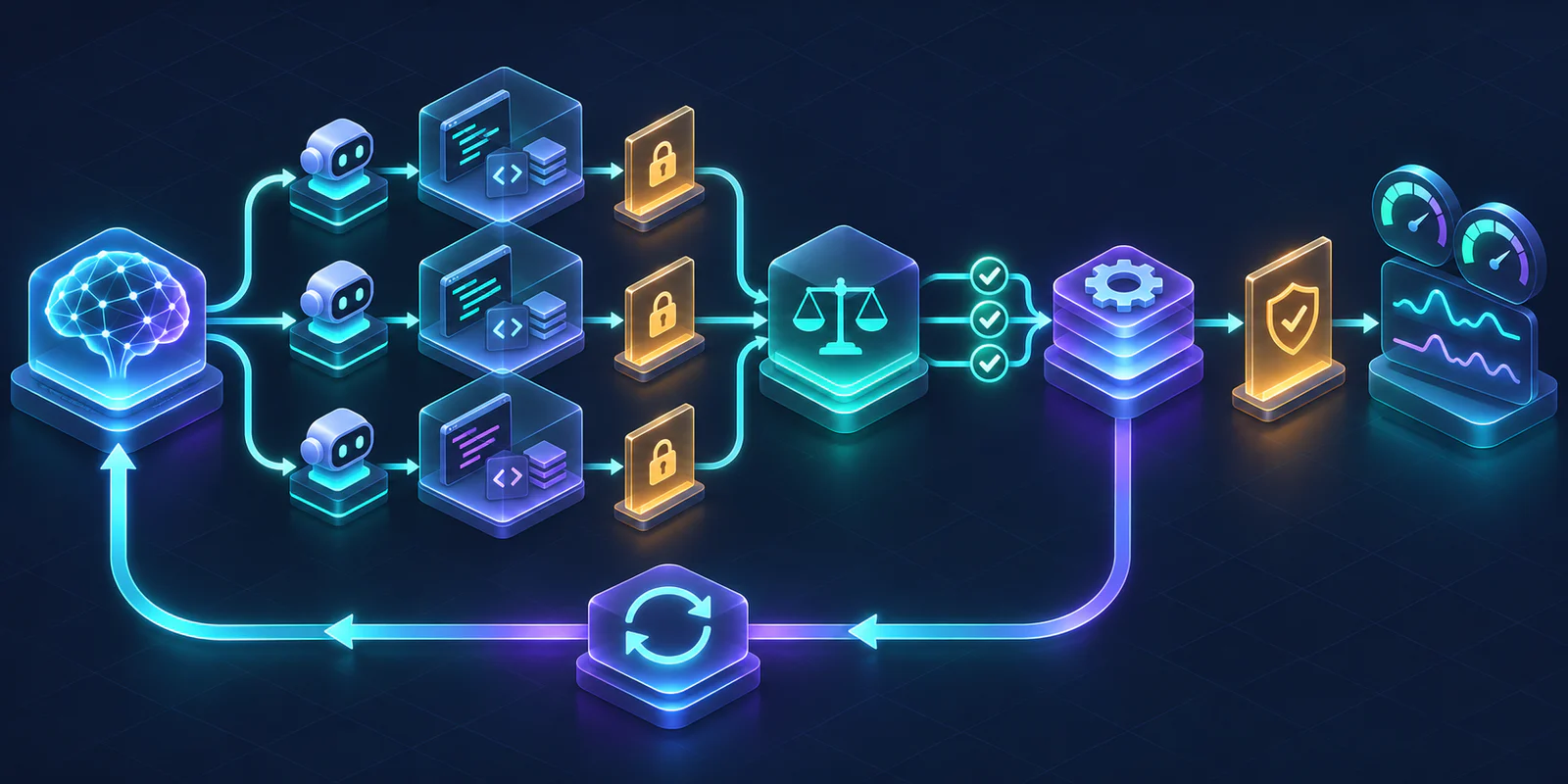
The clock does not measure one matrix multiplication. Each prompt starts several trajectories: the model reasons, calls tools, changes an isolated repository, and receives a reward when hidden tests validate the outcome. GRPO compares rewards within the group, estimates relative advantage, and updates the policy. The loop repeats generation and learning until an offline evaluation reaches the target. In this design, speeding up training alone can leave chips idle while sandboxes, builds, or tests finish; speeding up inference alone does not help if the optimizer, checkpoints, or network cannot feed the next step.
The rules fix elements that materially change difficulty: up to 30 agent turns, a maximum context of 65,536 tokens, reference prompts, stable problem ordering, and hidden tests the agent cannot edit. They also require disclosure of the immutable CodeAct harness commit and any deviations. At the same time, some knobs remain submitter choices, such as the maximum age of a trajectory before it is used in an update. That mixture is intentional: it fixes the semantics needed for comparison while leaving room to optimize the pipeline. When reading a result, inspect both the number and the disclosed implementation.
Chapter 03
What does the result prove, and what remains outside it?
The benchmark is valuable only when its evidence boundary is respected. A Closed result compares systems under a defined model, algorithm, data, agent contract, and quality target. This reduces variables and makes it more disciplined to attribute differences to the system. The same reduction prevents automatic extrapolation to a commercial agent: your product may use a different task distribution, remote tools, human review, context windows, budgets, or security rules.
| Signal | It supports | It does not support by itself |
|---|---|---|
| Time to quality | Full-system speed under the fixed workload | Quality beyond the target or on your own tasks |
| Published scale | Ability to run the disclosed configuration | Economic efficiency at a smaller scale |
| Closed division | Comparability under common constraints | Freedom to change model, data, or objective |
| Hidden tests | Resistance to modifying the visible verifier | Absence of reward hacking or security failures |
Chapter 04
Hypothetical example: decide whether to train, rent, or wait
Imagine a B2B company that wants to adapt an agent to resolve incidents in private repositories. The team sees an attractive MLPerf result and considers reserving a large cluster. Before signing, it builds a pilot with 200 authorized historical incidents, split by repository and date. Success means a correct patch, relevant tests passing, no prohibited changes, and acceptance through human review. The team measures trajectory time, sandbox failure rate, context length, zero-variance reward groups, accelerator utilization, cost per accepted patch, and regressions on a held-out suite. This is a hypothetical example: it does not claim results from Wasyra or a client.
If accelerators spend half their time waiting for builds and tests, buying more of them amplifies an external queue. If most groups receive the same reward, the learning signal is weak and the problem may be the data or verifier. If quality improves on known tasks but drops on held-out repositories, the bottleneck is generalization rather than speed. The pilot turns a public table into testable hypotheses and reveals whether you should optimize sandboxes, rewards, sampling, networking, or training capacity.
Chapter 05
Six questions for an infrastructure decision
First, does your workload resemble long tool-using rollouts or short offline fine-tuning? Second, is the objective to reduce calendar time, cost per validated improvement, or both? Third, which part of the loop consumes time: generation, sandboxing, evaluation, communication, or updating? Fourth, can you reproduce data, prompts, harness, and verifiers with immutable versions? Fifth, does the configuration fit your normal capacity, or depend on a scale you will not buy? Sixth, what held-out test and rollback prevent a reward gain from degrading safety or utility?
Instrument every question before comparing providers. Preserve identifiers for the dataset, checkpoint, policy, harness, and container; separate compute time from waiting; record failures by stage; and calculate cost over runs that reach quality rather than the nominal price of a chip. A fast run that does not converge, or must be repeated because of an unstable sandbox, is not cheap. Do not compare results with different divisions, quality targets, or scale as though they were equivalent.
- Entry criterion: a task distribution representative of real use.
- Exit criterion: held-out quality, cost, and time with variation intervals.
- Safety gate: tests the agent cannot see or modify.
- Operational gate: recovery for sandboxes, checkpoints, and failed runs.
Chapter 06
How do you evaluate without training to the scoreboard?
Separate three layers. The first is compliance: the pipeline reproduces the workload, reaches the threshold, and preserves auditable logs. The second is transfer: the checkpoint improves on held-out repositories and tasks that did not influence the reward. The third is operation: the agent respects permissions, budgets, timeouts, and human review in the product. An improvement in the first layer enables infrastructure comparison; only consistent improvement across all three justifies deploying the model.
The main risks are reward hacking, train-evaluation contamination, overfitting to the harness, mismatch between tests and user value, and hidden costs in external environments. Add negative canaries, adversarial task mutations, evaluation by repository family, and review of failed trajectories. Repeat enough runs to observe variance. The official benchmark requires at least three results for the post-training workload and handles extremes according to its rules; your pilot may need a different statistical design, but it should never depend on one lucky run.
Chapter 07
The decision: buy evidence, not only accelerators
MLPerf Training 6.1 makes one reality visible: training agents is not only running backpropagation, but coordinating rollouts, tools, sandboxes, verifiers, and updates until an agreed quality threshold is reached. Use the benchmark to shortlist capable architectures, identify pipeline patterns, and demand technical disclosure. Do not use it as a substitute for a business case, a generalization test, or a cost analysis at your scale.
The next reasonable action is to instrument a small, representative slice, measure its bottlenecks, and then decide whether you need better software, more capacity, or a different training objective. Wasyra can help design that evaluation and the custom agent system; the service is separate from the Agents product and should begin with your data, permissions, and acceptance criteria.
Written by
Wasyra Lab
AI systems and operations architecture
Wasyra Lab publishes practical frameworks for designing AI agents, automations, and operating flows that survive production.
Series
AI systems that actually reach production
A series on agents, copilots, and guardrails for bringing AI into real work without breaking trust or operations.
Posts in this seriesMore from this author
More from this author
AI Systems
Agent hooks: 7 tests before tools execute
AgentCore's new lifecycle hooks expose four control boundaries. This guide turns them into seven tests for authorization, failure, and auditability.
ArticleAI Systems
Scientific post-training: 7 evidence gates
Nemotron for Science opens scientific post-training. These seven gates prevent proxy optimization, test leakage, and false improvements.
ArticleKeep reading
Keep reading
AI Systems
Agent hooks: 7 tests before tools execute
AgentCore's new lifecycle hooks expose four control boundaries. This guide turns them into seven tests for authorization, failure, and auditability.
ArticleAI Systems
Scientific post-training: 7 evidence gates
Nemotron for Science opens scientific post-training. These seven gates prevent proxy optimization, test leakage, and false improvements.
ArticleAI Systems
Portable agent skills: production contracts
A portable skill does not transfer permissions or guarantees. Seven contracts separate instructions, tools, approval, testing, and rollback.
Article