Scientific post-training: 7 evidence gates
NVIDIA published a recipe for adapting scientific models with experimental data, verifiers, and RL. This guide turns that mechanism into seven decision gates for teams that need reproducible, safe improvements.
- Published
- min read
- 6 min read
- Categoría
- AI Systems
On this page
7 chapters- 01When should you post-train a scientific model?
- 02How does the verifiable-reward loop work?
- 03The seven gates before spending compute
- 04Hypothetical example: an agent for prioritizing assays
- 05What can go wrong with the dataset and verifier?
- 06How do you evaluate an improvement without fooling yourself?
- 07The decision: train the verifier before the model
Chapter 01
When should you post-train a scientific model?
Post-train only when a narrow task has experimental evidence, a defensible verifier, and a held-out test the training loop cannot contaminate.
On November 16, 2026, two America/Lima calendar days before this article, NVIDIA introduced Nemotron for Science and a technical recipe for adapting Nemotron 3.5 Super VL. The mechanism turns experimental records into prompts and reference answers, connects model output to a verifier, and uses that signal for supervised fine-tuning or reinforcement learning with verifiable rewards. The opportunity is real: an organization can adapt an open model to a concrete scientific prediction without labeling human preferences for every rollout. The risk is equally real: if the reward measures a weak approximation, if training and evaluation share entities, or if the verifier accepts an invalid answer, training can improve the score while making the science worse. The right decision does not begin with GPUs or the algorithm; it begins with seven gates that separate objective, evidence, reward, evaluation, safety, and operations.
In its drug-metabolism example, NVIDIA reports that SFT increased accuracy by 12% and RL post-training added another 17% under a 16,384-token output budget. This is a vendor result for one specific task, configuration, and metric, not a transferable promise for another laboratory. Treat it as evidence that the pipeline can learn from verifiable feedback, not as an estimate of improvement in your domain.
Chapter 02
How does the verifiable-reward loop work?
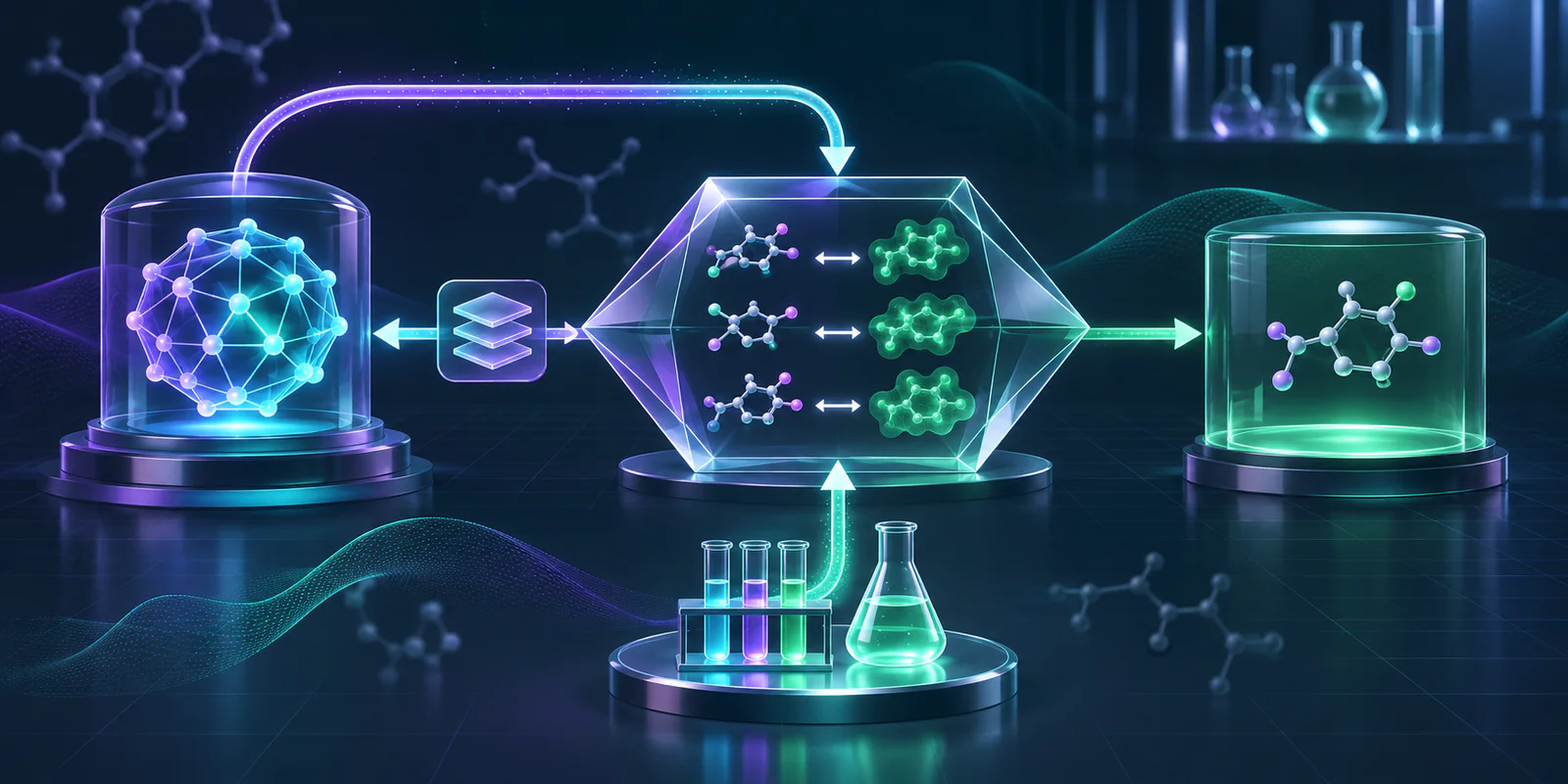
The pattern has four pieces. First, each experimental record becomes a task with inputs, context, and a reference outcome. Second, the agent produces a structured answer through a tool rather than free-form prose alone. Third, a resource server compares that answer with ground truth and returns a scalar reward. Fourth, the trainer uses groups of rollouts to update the policy. In the published example, the agent receives a parent molecule and an enzyme, submits the predicted metabolite as SMILES, and a verifier computes Tanimoto similarity between molecular fingerprints. The same scaffold can use a simulator, a scientific library, or even an automated laboratory, but changing the verifier changes the definition of success.
The recipe also proposes an optional distillation stage: a teacher model generates traces, the verifier filters those that reach a threshold, and accepted responses warm-start the student before RL. That can reduce the cold-start problem, but it does not turn the teacher's explanation into truth. A correct final answer may contain incorrect causal reasoning, and high molecular similarity may hide a difference that matters for the use case. Track syntactic validity, proxy score, scientific correctness, and operational usefulness separately.
Chapter 03
The seven gates before spending compute
Gate 1, task contract: define a narrow decision, the prediction unit, inputs available at runtime, and what counts as valid abstention. Gate 2, data lineage: record source, license, version, date, transformations, and exclusions for every example. Gate 3, isolation: split training, validation, and test by the entity that could leak signal—molecule, family, patient, experiment, site, or time—not merely by random rows. Gate 4, verifier validity: measure false positives and false negatives against expert review, adversarial cases, and outputs that look close but are scientifically unacceptable.
Gate 5, ablation: compare the base model, SFT, distillation plus SFT, and RL on the same held-out test so you know which stage adds value and which merely adds cost. Gate 6, environment safety: constrain tools, networking, sensitive data, duration, and budget; preserve inputs, tool calls, versions, and rewards for audit. Gate 7, promotion: require repeatable improvement on the held-out test, no critical regressions, defined human review, a canary, rollback, and an operational owner. Failing a gate does not mean abandoning the project; it shows whether data, reward, harness, or the use case must change before more capacity is purchased.
| Layer | Exit evidence | Blocking failure |
|---|---|---|
| Data | Lineage and splits without shared entities | Unclear license or leakage |
| Reward | Measured agreement with scientific judgment | Easily exploited proxy |
| Model | Repeatable improvement over baseline | Gain only on training data or one run |
| Operations | Canary, review, traceability, and rollback | Irreversible action without control |
Chapter 04
Hypothetical example: an agent for prioritizing assays
Imagine a biotech company that wants to prioritize which compounds advance to an expensive assay. The team has authorized historical results and a fast but imperfect simulator. Instead of training on the entire database, it first freezes a temporal test set from later campaigns and separates molecular families across splits. The agent may only propose a shortlist and explain uncertainty; it cannot order an experiment or write to the laboratory system. The reward combines structural validity, simulator score, and a penalty for repeated proposals, but promotion is decided through the held-out assay and chemist review. This example is hypothetical and does not describe a Wasyra client or result.
The comparison includes four checkpoints: base, SFT with verified examples, distilled SFT, and RL. Each runs multiple times with recorded seeds. The dashboard separates coverage, accuracy, calibration, abstention rate, diversity, cost per accepted candidate, and critical errors. If RL raises the simulator score but concentrates proposals in one familiar family, it fails the usefulness gate. If distillation improves answers but introduces unsupported explanations, keep the simpler model or change the corpus. The goal is to find the smallest system that improves held-out decisions, not to maximize an isolated reward.
Chapter 05
What can go wrong with the dataset and verifier?
LitmusBench v0.2 makes the open-data promise concrete: its public card shows 47.1 thousand training rows, chemical properties, expected answers, JSON format, and declared licenses. Availability is not the same as suitability. Before mixing it with proprietary data, review per-record provenance, license compatibility, duplicates, source versions, property coverage, and whether the same compound appears under different prompts. A random split can place near-identical variants in training and test, measuring recognition rather than transfer.
There is also reward hacking that is perfectly rational from the optimizer's perspective. If the parser accepts extra text, the model may learn a format that earns points without satisfying the contract. If Tanimoto rewards similarity when exact identity is required, it may favor nearby but useless molecules. If the simulator has a blind spot, RL will find it. Test the verifier with malformed, equivalent, nearly correct, adversarial, and out-of-distribution answers; version its code; and change the reward only through review, because every change redefines the experiment.
Chapter 06
How do you evaluate an improvement without fooling yourself?
Define the plan before training. Freeze hashes for data, verifier code, base model, prompt, tools, and container. Choose a primary metric tied to the scientific decision and secondary metrics for safety, calibration, diversity, latency, and cost. Establish how many repetitions you need, what minimum difference matters, and which regressions are unacceptable. Report distributions and failures, not only averages. Keep one test set that no teacher, trace selection, reward adjustment, or hyperparameter search can inspect.
Then review three boundaries. Internal validity: does the gain come from training rather than leakage or harness changes? Transfer: does it survive new entities, dates, instruments, or sites? Operations: does the model still respect permissions, abstention, time limits, and human review? Promote only a checkpoint that passes all three. A reproducible proxy gain may justify another iteration; by itself, it does not authorize a scientific or clinical decision.
Chapter 07
The decision: train the verifier before the model
Nemotron for Science narrows the distance between experimental data and a reproducible post-training pipeline. Its value to a company is not in copying a 16-GPU configuration, but in making the contract explicit: a narrow task, structured tool, versioned reward, ablation comparison, and held-out test. If you cannot defend the verifier to a domain expert, you do not yet have a signal for RL; you have a hypothesis to validate.
Start with a small slice, an auditable reward, and the base model as a competitor. Run the seven gates before scaling, and preserve the option to conclude that prompting, retrieval, or tools solve the problem without changing weights. Wasyra can help design the evaluation and custom agent system around your data and permissions; that service is distinct from the Agents product and should advance only as fast as the evidence allows.
Written by
Wasyra Lab
AI systems and operations architecture
Wasyra Lab publishes practical frameworks for designing AI agents, automations, and operating flows that survive production.
Series
AI systems that actually reach production
A series on agents, copilots, and guardrails for bringing AI into real work without breaking trust or operations.
Posts in this seriesMore from this author
More from this author
AI Systems
Agent hooks: 7 tests before tools execute
AgentCore's new lifecycle hooks expose four control boundaries. This guide turns them into seven tests for authorization, failure, and auditability.
ArticleAI Systems
Agentic RL: how to read MLPerf Training 6.1
MLPerf now measures agent post-training. Learn how to read time to quality, workload limits, and useful infrastructure decision signals.
ArticleKeep reading
Keep reading
AI Systems
Agent hooks: 7 tests before tools execute
AgentCore's new lifecycle hooks expose four control boundaries. This guide turns them into seven tests for authorization, failure, and auditability.
ArticleAI Systems
Agentic RL: how to read MLPerf Training 6.1
MLPerf now measures agent post-training. Learn how to read time to quality, workload limits, and useful infrastructure decision signals.
ArticleAI Systems
Portable agent skills: production contracts
A portable skill does not transfer permissions or guarantees. Seven contracts separate instructions, tools, approval, testing, and rollback.
Article