Cybersecurity AI: how to govern access by tier
Anthropic's Cyber Verification Program turns access to advanced cyber models into an architecture decision. This guide translates its tiers and requirements into an operating contract other teams can evaluate without confusing user verification with system safety.
- Published
- min read
- 9 min read
- Categoría
- AI Systems
On this page
11 chapters- 01A dual-use capability cannot be governed with a binary permission
- 02The mechanism: bind capability, identity, and environment
- 03Control 1: turn authorization into an executable contract
- 04Control 2: individual identity and short-lived credentials
- 05Control 3: separate workspaces, data, and tools
- 06Control 4: constrain tools and egress outside the agent
- 07Control 5: correlated monitoring with a privacy boundary
- 08Control 6: evaluate utility, containment, and response together
- 09Hypothetical example: a fintech vulnerability lab
- 10Limits: an access program is not a certification
- 11The right capability should exist only in the right context
Chapter 01
A dual-use capability cannot be governed with a binary permission
A model capable of analyzing malware, reproducing an exploit, and operating tools can help close a vulnerability or accelerate an attack. The same prompt changes meaning depending on the asset, authorization, environment, and person executing it. A control that only decides allow or block creates two predictable failures: it stops legitimate defensive work or grants an offensive surface that is too broad to any account that passes an initial review.
Anthropic announced an expansion of its Cyber Verification Program on October 6, 2026 with three access tiers: Defense, Red Team, and Specialized. Each tier reduces blocks for a different scope while raising requirements for identity, credentials, devices, networking, and response. The news matters beyond one provider: it proposes treating advanced capability as a conditional and revocable grant, not as a permanent property of the model or user.
Chapter 02
The mechanism: bind capability, identity, and environment
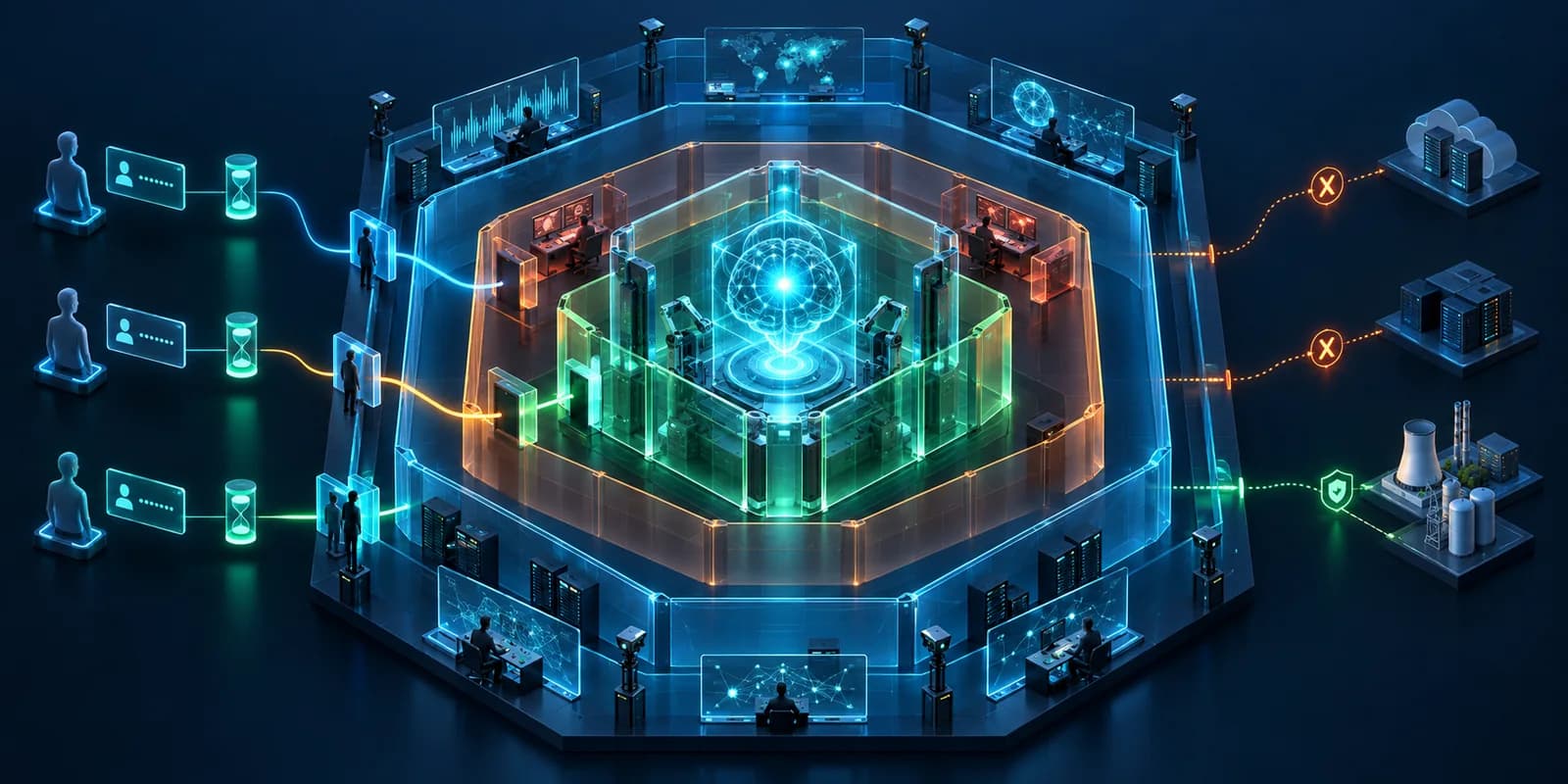
Defense Access covers work such as incident response, malware reverse engineering, and vulnerability validation. Red Team adds adversarial testing of authorized systems while retaining blocks on actions that could cause physical harm or mass disruption. Specialized reserves the fewest blocks for verified organizations testing critical systems such as power grids, telecommunications, or interbank transfers. These are not three different models: they are different combinations of allowed capability and obligations around its use.
That moves the decision from the model picker into a control plane. The plane must answer who is requesting access, for which asset, with what authorization evidence, from which workspace, using which credential, tools, and network destinations, and under what monitoring. Verifying a company at enrollment is not enough. The grant must remain bound to those conditions during every session and disappear when the role, project, or risk changes.
Chapter 03
Control 1: turn authorization into an executable contract
Start with a matrix connecting task, asset, environment, and evidence. Analyzing a binary submitted by a client is not equivalent to scanning the Internet; reproducing a flaw in a lab does not authorize touching production; membership in a red team does not prove that a domain is in scope. The system should admit a request only if it can resolve the asset owner, approved window, allowed technique, and responsible person or workload.
Model the grant with expiry and conditions, not as an eternal role. A minimal entry can include subject, purpose, asset IDs, tool set, egress allow-list, start, expiry, and approval reference. The inference policy should read that contract before enabling sensitive capabilities and record which condition determined the outcome. An audit can then reconstruct why one session received more capability than another without depending on a screenshot of the admin panel.
Chapter 04
Control 2: individual identity and short-lived credentials
The published requirements prohibit shared sessions and require attribution to a person or workload. For higher tiers, they require phishing-resistant MFA, corporate-domain accounts, and credentials issued by the platform's native identity service. The reason is operational: if one static API key represents the whole team, you cannot distinguish misuse, revoke one user, or prove who initiated an action after an incident.
Separate people from services. A person gets access after SSO and WebAuthn; an automated agent uses workload federation, least scope, and short expiry. The gateway validates issuer, audience, subject, workspace, and grant on every call without turning a valid token into universal permission. For customer-operated credential systems in Red Team and Specialized, Anthropic sets a maximum of twelve hours and requires the ability to revoke compromised identities within twenty-four hours; these are program requirements, not a universal security benchmark.
Chapter 05
Control 3: separate workspaces, data, and tools
An organizational grant should not automatically appear in every project. Create dedicated workspaces by program or client, with named members, separate stores, and explicit tools. A malware analyst may need a disassembler and isolated samples but not deployment credentials. An agent reviewing code may read a repository and open a finding but does not need production secrets or access to other tenants.
Segmentation also limits the context blast radius. If prompts, files, transcripts, and tool results live in one general space, an innocent query can retrieve material from a sensitive investigation. Apply namespaces by grant, retrieval policies, encryption and keys by environment, and prevent memories or caches from crossing boundaries. Test isolation with negative cases: a valid user in the wrong workspace should receive an observable denial, not partial data.
Chapter 06
Control 4: constrain tools and egress outside the agent
A system prompt saying not to leave the lab does not contain execution. The tool-running process must live in a sandbox that cannot modify its own policy. Networking is restricted with an allow-list enforced outside the host, destinations are resolved before execution, and every connection is logged. CVP requirements use this boundary for offensive or agentic work in Red Team and Specialized: the workstation can remain flexible, but the sensitive action occurs where the agent does not control egress.
Apply the same principle to tools. Define strict schemas, rate limits, quotas, file paths, and confirmations for irreversible actions. A scanner receives targets from the scope contract, not free text; an exploitation tool points only to the ephemeral environment created for the test; a reporting function can write evidence but cannot delete logs. The model proposes an action and the runtime authorizes it against current state. That separation remains necessary even when the provider already applies safety classifiers.
Chapter 07
Control 5: correlated monitoring with a privacy boundary
The program requires retention to detect misuse and attribute activity. The problem is that dangerous signals can appear across several sessions or accounts, while analyzed material can contain proprietary code, personal data, or regulated information. Logging everything without purpose creates another risk; discarding each interaction immediately prevents pattern correlation. Define minimum events: identity, grant, tool, normalized target, policy decision, outcome, and a hash of sensitive evidence.
Then define who stores the data, who can read it, for how long, and what triggers human review. Anthropic describes Enterprise Frontier Safeguards as a future architecture where logs remain in the customer's cloud under its keys and automated signals reach its team. Today, CVP retains exceptions and platform dependencies. Treat this as an announced capability in phased rollout, not a guarantee already available to every integration. Before adopting, confirm region, retention, roles, and deletion procedures with the specific provider.
Chapter 08
Control 6: evaluate utility, containment, and response together
Do not evaluate only how many tasks the model completes. Build a set containing allowed work, out-of-scope requests, ambiguous targets, revoked identities, unauthorized tools, and sequences that distribute risk across sessions. Measure defensive-task utility, correct-block rate, prohibited-action escapes, false positives, complete attribution, and time to revocation. Repeat across multiple attempts: a policy that fails once in fifty still has an exploitable path.
Anthropic reports that in its CyScenarioBench evaluation, Defense blocked 46 of 50 attempts at some point, while Red Team did not block and completed 34 of 50. This is a provider measurement on Claude Opus 5.5 under a specific configuration; it does not prove the safety of your gateway or the quality of your operation. Reproduce your own scenarios, run tabletop incidents, and require the team to suspend a seat, revoke a workload, isolate the sandbox, and preserve evidence within defined times.
Chapter 09
Hypothetical example: a fintech vulnerability lab
Suppose a fintech wants to use an agent to validate vulnerabilities against an isolated copy of its transfer API. This example is hypothetical and does not describe a Wasyra client. Security creates a Red Team grant for eight people, restricted to a clone with no real data, during a four-hour window. Each member enters through SSO and a passkey; the runner uses workload federation; the gateway accepts only the lab IDs and three versioned tools.
The sandbox network can reach only the target, an approved package repository, and the evidence collector. The agent can propose and execute tests within quota, but any attempt to change destination or elevate privileges is rejected outside the model. Logs preserve decisions and hashes; sensitive payloads remain encrypted in the team's account. When the window closes, expiry, revocation, and environment destruction are tested as part of the outcome, not treated as informal cleanup.
The pilot is not approved because it found more flaws. It passes if it improves defensive coverage without escaping scope, every action preserves attribution, false blocks remain manageable, and the incident drill meets its time objective. A critical finding still requires independent reproduction, triage, and a disclosure or remediation process. The agent accelerates an existing discipline; it does not replace authorization or professional accountability.
Chapter 10
Limits: an access program is not a certification
The announcement and documentation describe Anthropic controls, not an independent standard or third-party audit. Its vulnerability figures come from the provider and partial participant reports using different methods; the announcement itself acknowledges incomplete patch data and extrapolates likely impact. Do not use those numbers to forecast productivity, economic return, or incident reduction in your company.
Do not assume that a tier transfers permissions across providers or clouds in the same way. CVP has different availability and provisioning across Claude Platform, Vertex AI, Microsoft Foundry, and Bedrock, and some capabilities still depend on Enterprise Frontier Safeguards. Verify the actual contract, technical controls, and region before designing. Keep your own defenses as well: DLP, secret management, data classification, tool review, and an incident channel should not depend on a single model classifier.
Chapter 11
The right capability should exist only in the right context
The useful contribution of tiered access is turning dual-use risk into verifiable conditions. Executable scope, individual identity, short-lived credentials, separated workspaces, contained tools and egress, bounded monitoring, and rehearsed response form one system. If one piece is missing, verifying the applicant does not prevent a legitimate session from overflowing its scope or a compromised credential from retaining power.
Before requesting broader access, document which task is blocked today, the minimum capability that resolves it, and the controls you can demonstrate. Then test utility and containment with equal rigor. If you need to turn that contract into an operable AI pilot, Wasyra can help design the control plane, evaluation, and gradual rollout without confusing advanced access with unlimited authority.
FAQ
Frequently asked questions
Does verifying a company make access to cyber capabilities safe?
No. Verification reduces uncertainty about identity and purpose, but it must be paired with executable scope, short-lived credentials, isolation, tool and network limits, monitoring, revocation, and incident response.
What should a pilot prove before access expands?
It should demonstrate utility on allowed tasks, consistent rejection outside scope, complete attribution, isolation across workspaces, revocation within target, and evidence preservation without crossing the privacy boundary.
Written by
Wasyra AI Systems
Trust, copilots, and enterprise adoption
Wasyra AI Systems covers guardrails, suggestion-first modes, and review design so work assistants earn real adoption.
Series
AI systems that actually reach production
A series on agents, copilots, and guardrails for bringing AI into real work without breaking trust or operations.
Posts in this seriesMore from this author
More from this author
AI Systems
Model extraction: how to protect your AI gateway
Six controls for detecting coordinated model extraction without blocking legitimate customers or turning every prompt into a false alarm.
ArticleAI Systems
Async agents: how to keep work moving without blocking
Five gates that let an agent advance while slow tools run without losing dependencies, control, state, or evidence.
ArticleKeep reading
Keep reading
AI Systems
Model extraction: how to protect your AI gateway
Six controls for detecting coordinated model extraction without blocking legitimate customers or turning every prompt into a false alarm.
ArticleAI Systems
Async agents: how to keep work moving without blocking
Five gates that let an agent advance while slow tools run without losing dependencies, control, state, or evidence.
ArticleAI Systems
Computer-use agents: how to evaluate desktop automation
Five gates for deciding whether an agent that sees, clicks, and types in desktop apps can operate without losing control or evidence.
Article