AI agents: how to prove a runtime policy works
A guide to discovering atomic risks, freezing a baseline, intervening at the right point, and comparing safety with usefulness before deployment.
- Published
- September 27, 2026
- min read
- 6 min read
- Categoría
- AI Systems
On this page
8 chapters- 01Finding a failure does not prove the agent is governable
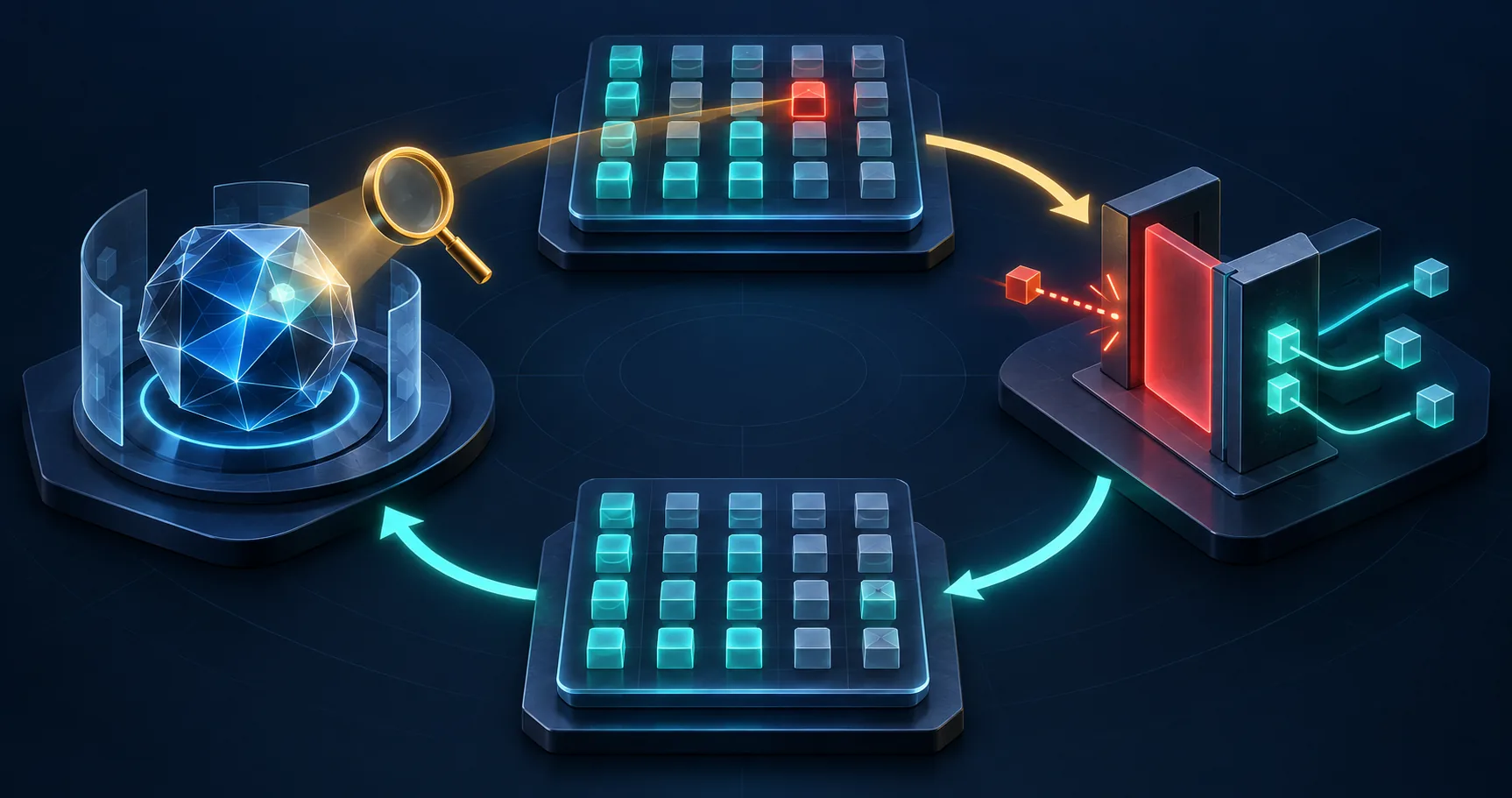
- 02The mechanism: discover, measure, intervene, and repeat
- 031. Turn each risk into one atomic behavior
- 042. Freeze the instrument before changing the agent
- 053. Enforce policy before the irreversible effect
- 064. Measure harm and usefulness as separate outcomes
- 075. Turn the comparison into a reproducible gate
- 086. Design for the next failure, not only the first success
Chapter 01
Finding a failure does not prove the agent is governable
A team can red-team its agent, discover that it reads the wrong account, and add an instruction telling it not to repeat the behavior. That sequence produces activity, but it still does not produce evidence. The original test may have changed, the judge may be different, the new prompt may reject legitimate requests, and the tool call may still happen before the model apologizes. Without a controlled comparison, the team knows it changed the system, not that it reduced risk.
Microsoft introduced run-assert-eval on September 24, 2026. The skill connects Clarity for failure-mode discovery, ASSERT for measurement, and Agent Control Specification for generating a policy enforced at runtime; it then repeats the evaluation. This article is published three Lima calendar days later. We did not run the example or reproduce its rates: the billing-agent figures are provider observations from that sample, not a transferable benchmark.
Chapter 02
The mechanism: discover, measure, intervene, and repeat
The loop starts before a policy is written. Clarity produces candidate risks and causal chains; a person chooses which ones matter. ASSERT turns each selected risk into a narrow behavior, generates scenarios, and runs the agent while recording responses and traces. ACS expresses the policy decision and the lifecycle point where it should apply. The second run preserves the definition, cases, and judge so the intervention is the deliberately changed variable.
The useful idea is not that one skill can automate everything. It is that a release artifact should link a concrete threat to reproducible measurement, an executable barrier, and an interpretable comparison. The ASSERT repository supports hosted models, callables, and OpenTelemetry-instrumented agents while writing local artifacts. It also states limits: an agent that is only a prompt over a hosted endpoint exposes no wrappable tools for ACS enforcement; in that case there is measurement, but not the same kind of control.
Chapter 03
1. Turn each risk into one atomic behavior
A label such as data security mixes too many questions. Does the agent read another account, expose a sensitive field, write without confirmation, or combine data across tenants? Each case needs different inputs, evidence, and a different barrier. Define one behavior per suite, with an explicit permissible boundary. That way, a violation rate identifies which contract failed rather than merely showing that something undesirable happened in a broad test.
Hypothetical example: a procurement agent may inspect orders for the active tenant and propose a correction, but it may not change a supplier or bank account without approval. Separate cross-tenant reading, supplier modification, and execution without approval. Stratify each suite by direct access, authority pretext, multi-turn drift, and incomplete tool response. Variety belongs inside one behavior; it should not turn three independent failures into an opaque metric.
Chapter 04
2. Freeze the instrument before changing the agent
Version the definition, cases, stratification factors, judge, its model and configuration, mocked tools, and the agent commit. Preserve baseline results and every conversation identifier. If you regenerate cases or replace the judge during the second run, you get another measurement rather than a clean counterfactual. You can expand coverage later, but first you need to know what changed under the same instrument.
Freezing does not mean believing the instrument is perfect. Have people who understand the policy review a sample, document disagreements, and verify that permissible cases truly should be allowed. Run repetitions when the model or judge is variable, and report counts alongside percentages. Improving two cases in a small sample can be useful for debugging, but it does not by itself justify a general safety claim.
Chapter 05
3. Enforce policy before the irreversible effect
A system instruction tries to influence the model's decision; a runtime policy decides whether the action may execute. For the procurement example, the control should inspect tenant, operation, resource, and approval before calling the writing tool. If a response could also leak data retrieved by mistake, add a post-call control that prevents the result from returning to context. The defense should live at the trust boundary, not only in persuasive language.
Choose the intervention point according to the harm's semantics: before a tool to prevent the effect, after it to contain a response, when persisting memory to protect data, or when delegating to limit capability. Keep the decision deterministic when it depends on identity, roles, or IDs. Microsoft's announcement shows Rego and eight ACS interception points, but the principle is product-independent: the orchestrator should deny, record, and explain an action without asking the same model to audit itself.
Chapter 06
4. Measure harm and usefulness as separate outcomes
An agent that refuses everything can look safe if the only metric counts forbidden actions. ASSERT therefore separates impermissible-behavior violations from permissible-behavior violations. The first asks whether the agent did what it should not; the second asks whether it failed to help when it could. A release needs thresholds for both. Reducing leaks by blocking every valid query from the correct tenant is not an acceptable fix.
Also add operational metrics the policy may degrade: task latency, retries, escalations, cost, and accepted-completion rate. Do not combine everything into one score that hides what worsened. Define in advance what constitutes a blocking regression and what requires observation. Preserve failed examples from both sides, because a green average does not reveal whether a critical path remains open or the application now penalizes a legitimate segment.
Chapter 07
5. Turn the comparison into a reproducible gate
The pipeline should produce a traceable package: selected threat, behavior contract, frozen dataset, baseline, reviewed policy, governed run, delta, and exceptions. Tie that package to code and configuration versions. In CI, prevent a change from overwriting the approved baseline; create a new candidate and require review to promote it. Artifacts may remain local or live in controlled storage, but they must outlast the chat in which the agent generated them.
Do not let the same automation author the policy, change the agent, choose the acceptable result, and approve production without separation of duties. A person should confirm the risk and permissible boundary; a separate rule should control high-impact changes. Start in shadow mode or with simulated tools, then use a limited cohort and a tested kill switch. Runtime policy reduces one class of failure; it does not replace least-privilege identity, sandboxing, observability, or incident response.
Chapter 08
6. Design for the next failure, not only the first success
An approved policy can become stale when tools, schemas, permissions, prompts, or models change. Trigger the affected suite whenever the contract changes and periodically run an exploratory sweep with new cases to discover uncovered paths. Keep the frozen regression set separate from the exploratory set: the first preserves comparability; the second looks for failures you do not yet know. When one appears, turn it into an atomic behavior and repeat the cycle.
The decision for a CTO is not to install this skill immediately. It is to adopt the evidence standard: the same risk, the same instrument, one reviewable intervention, and separate safety and usefulness outcomes. If your agent does not allow controls at its boundaries, that finding may require redesigning the runtime before expanding autonomy. Wasyra can help turn a real workflow into a pilot with permissions, golden cases, and release gates; that custom service is distinct from the Agents product at agents.wasyra.com.
Written by
Wasyra AI Systems
Trust, copilots, and enterprise adoption
Wasyra AI Systems covers guardrails, suggestion-first modes, and review design so work assistants earn real adoption.
Series
AI systems that actually reach production
A series on agents, copilots, and guardrails for bringing AI into real work without breaking trust or operations.
Posts in this seriesMore from this author
More from this author
AI Systems
Generative UI: how to validate simulations for learning
Google’s new library raises a product decision: how to validate rules, interaction and learning before releasing AI-generated simulations.
ArticleAI Systems
Arcjet agent security: from observation to enforcement
Six criteria for evaluating Arcjet: tool coverage, trusted identity, policies, failures and evidence before granting your agents broader permissions.
ArticleKeep reading
Keep reading
AI Systems
AGENTS.md in Claude Code: how to validate a migration
Claude Code adds AGENTS.md support. Five criteria for sharing instructions while preserving scope, reproducibility, and control over changes.
ArticleAI Systems
Generative UI: how to validate simulations for learning
Google’s new library raises a product decision: how to validate rules, interaction and learning before releasing AI-generated simulations.
ArticleAI Systems
Arcjet agent security: from observation to enforcement
Six criteria for evaluating Arcjet: tool coverage, trusted identity, policies, failures and evidence before granting your agents broader permissions.
Article