Shirudo: how to evaluate agent-written runtime shields
Shirudo opens a path for agents to investigate vulnerabilities and prepare small protections for running Linux systems. The useful decision is not whether an agent can write eBPF, but whether the organization can prove that each mitigation blocks the exploit, preserves legitimate traffic, limits its scope, can be rolled back, retains provenance, and works across the real fleet without confusing a valid signature with correct code.
- Published
- min read
- 7 min read
- Categoría
- Engineering
On this page
7 chapters- 01The gap between discovery and patching is now a product decision
- 02What the mechanism does and does not prove
- 03Six gates before authorizing a shield
- 04Hypothetical example: a payments API that cannot restart immediately
- 05When to experiment, when to wait, and how to constrain a pilot
- 06Limits the announcement does not remove
- 07The advantage is not autonomy: it is compressing the gap with control
Chapter 01
The gap between discovery and patching is now a product decision
A confirmed vulnerability does not automatically turn an urgent patch into a safe fleet-wide change.
OpenAI and Cisco announced Shirudo on November 23, 2026, two America/Lima calendar days before this publication. The open project proposes protecting running Linux systems while a team prepares and distributes the permanent patch. In the controlled test described by OpenAI, a Codex-generated shield blocked a Java4Shell exploit attempt against Elasticsearch without restarting the service. That result is evidence from one vendor-controlled case, not proof of general production readiness or effectiveness across every vulnerability, kernel, or workload.
The operating problem is real: testing a fix, coordinating owners, rebuilding images, and rolling out in stages can take longer than exploitation. Yet a temporary shield also changes the behavior of a critical machine. The opportunity should therefore not be sold as autonomous patching. It is a new, time-bounded unit of change: it starts with evidence about a vulnerable path, passes through separate evaluation, receives human approval, deploys with explicit scope, and disappears once the permanent patch proves it can replace it. If those states do not exist in the workflow, agent speed merely accelerates an opaque decision.
Chapter 02
What the mechanism does and does not prove
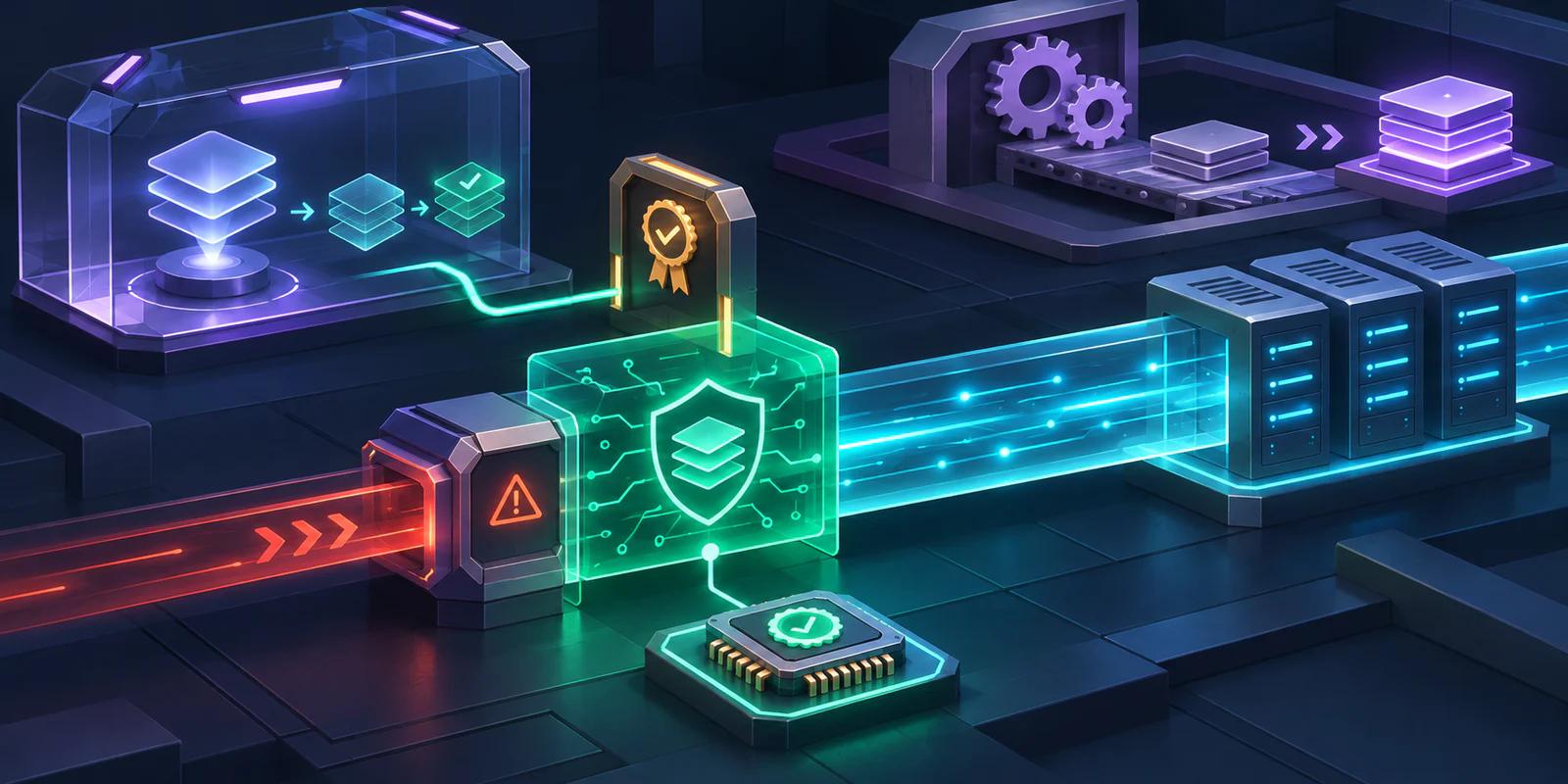
Shirudo uses BPF—the name its documentation uses for eBPF—to attach small programs at specific kernel points. A mitigation can observe a signal, block a vulnerable path, or alter behavior without stopping the application. In the published architecture, the operator builds BPF or application-bytecode upatches, packages and signs them, and distributes them through an OCI registry. The target verifies the signature, loads the change, and records operations in a TPM-backed measurement. The goal is to separate the machine that prepares a change from the machine that executes it and retain verifiable evidence of what was loaded or removed.
That chain provides identity and integrity, not semantic correctness. The documentation itself says the platform does not understand what an upatch does: it ensures that only authorized BPF runs and that the change is recorded. A signature proves that an approved key authorized an artifact; it does not prove that the artifact blocks the right exploit, preserves valid traffic, or reflects a correct agent interpretation of the vulnerability. The BPF verifier checks program safety rules inside the kernel, but it does not replace business tests, compatibility checks, or adversarial evaluation. This distinction must appear in both the approval interface and the audit trail.
Chapter 03
Six gates before authorizing a shield
The agent proposal should be treated as a reversible candidate, not as a completed security answer.
The pipeline needs at least two oracles: a case that reproduces the attack and a legitimate workload that must not break. It must then add operating properties that the exploit does not observe. Every gate result should be bound to the hash of the exact artifact; rebuilding, changing the kernel, or modifying a rule invalidates affected evidence. The following six gates form a minimum contract. They are not a universal benchmark: each organization must add controls based on criticality, data, jurisdiction, and recovery capability.
- Exploit blocking: the reproducible attack fails with the shield and works again when it is removed, without relying on the agent's verbal description.
- Legitimate workload preservation: canaries, integration tests, and representative traffic verify allowed paths, latency, errors, and resource use.
- Minimum scope: hooks, processes, versions, hosts, and duration are constrained; a broad mitigation requires proportionally stronger evidence.
- Rehearsed rollback: removing the shield is a tested, observable operation that remains available even if the agent control plane fails.
- Provenance and authority: vulnerability source, prompt, tools, code, signed artifact, approver, and expiration form a queryable chain.
- Compatibility and attestation: the real kernel supports the required ABI, measured state matches the approval, and telemetry confirms per-host state.
Chapter 04
Hypothetical example: a payments API that cannot restart immediately
Suppose a payments platform confirms a vulnerability in a library that processes a rarely used header. A vendor patch exists, but updating requires rebuilding a base image and repeating integration certification. This example is hypothetical and does not describe a Wasyra client or result. The team reproduces the exploit with synthetic data in an isolated clone. The agent proposes an upatch that rejects only the dangerous combination of process, function, and input shape. Security reviews the diff, compiles it on a builder with no production access, and runs positive and negative cases.
The first canary receives one percent of traffic in one region for thirty minutes. The team compares errors, latency, rejected paths, and attested state against the baseline. An approver other than the author expands to ten percent; automation cannot skip that limit. The shield carries a 24-hour expiration, and rollback was tested before deployment. Meanwhile, another flow validates the permanent patch. Once that patch passes its own canary, the system removes the shield, confirms that measured state changed, and retains both histories. The agent accelerated investigation and code, but it never owned the production key.
Chapter 05
When to experiment, when to wait, and how to constrain a pilot
Shirudo should currently be evaluated as early infrastructure, not as a direct replacement for a patching program. Its documentation requires a bpf-next kernel with a signed-loader ABI and several specific changes; it states that there is no compatibility mode or fallback for older kernels. The repository publishes a test-kernel build as a pre-release. For most teams, that rules out beginning on general production. A reasonable pilot belongs in a reproducible lab, uses a pinned kernel version, a well-understood vulnerability, synthetic workloads, and no key that can deploy beyond that environment.
Experimentation makes sense when the team already operates Linux at a low level, can build controlled kernels, has mature incident response, and needs to reduce a measurable patch gap. Waiting makes sense when the team relies on managed kernels without extensions, lacks canaries, or cannot separate creation, signing, and approval. The decision is not binary: a team can first adopt the operating model—temporary candidates, dual oracles, expiration, and rollback—using existing controls such as a WAF, runtime rules, or feature flags. That develops the process before adding a new root of trust inside the kernel.
Chapter 06
Limits the announcement does not remove
Shirudo expands the trusted base. The builder, keys, registry, modified kernel, TPM, approval policy, and telemetry system all become part of the defense. An attacker who controls the kernel can bypass checks running inside that same kernel; the documentation acknowledges this and positions upatches as one defense-in-depth layer. Operational risk remains as well: an overly broad filter can create silent unavailability, an expensive hook can degrade latency, and a shield that never expires can hide patch debt.
The published evaluation also does not establish a general success rate, overhead for your workloads, or an independent comparison against other mitigation techniques. Do not turn the Java4Shell or PHP examples into a forecast for productivity, response time, or incident reduction. Measure in your environment: time to candidate, rejection rate in review, false positives, resource impact, rollback time, and time until the permanent patch. The healthy indicator is not how many shields an agent generates, but how many exposures it reduces with complete evidence and without prolonging the temporary state.
Chapter 07
The advantage is not autonomy: it is compressing the gap with control
Shirudo signals an important direction: an agent can work closer to the runtime and produce narrow mitigations while permanent software follows its normal lifecycle. But the closer it operates to the kernel, the more explicit the separation between proposing, verifying, signing, and deploying must become. Start in a lab, require all six gates, keep the permanent patch as the mandatory exit, and design expiration before the first shield. If you need to turn that discipline into an operable pipeline, Wasyra can help design the architecture, permissions, and evidence without confusing a technical demonstration with production readiness.
Written by
Wasyra Engineering
Modernization, architecture, and reliable delivery
Wasyra Engineering documents patterns for moving legacy systems without freezing delivery or breaking ownership.
Series
AI systems that actually reach production
A series on agents, copilots, and guardrails for bringing AI into real work without breaking trust or operations.
Posts in this seriesMore from this author
More from this author
Engineering
AI data centers: design flexible demand
Flexible demand requires more than turning off GPUs: contracts, scheduling, recovery, telemetry, and costs must be tested together.
ArticleEngineering
Kubernetes inference: validate the full runtime
A healthy endpoint does not prove the platform. Seven gates validate compatibility, scheduling, routing, observability, and rollback.
ArticleKeep reading
Keep reading
Engineering
AI models: contracts that catch regressions
Model Integration Contracts bring real paths, small fixtures, and reviewed baselines into CI without promising total coverage.
ArticleEngineering
AI data centers: design flexible demand
Flexible demand requires more than turning off GPUs: contracts, scheduling, recovery, telemetry, and costs must be tested together.
ArticleEngineering
Kubernetes inference: validate the full runtime
A healthy endpoint does not prove the platform. Seven gates validate compatibility, scheduling, routing, observability, and rollback.
Article