Gemini 3.8 Live: coordinating voice, tasks and interruptions
Google’s new voice models invite a closer look at how applications coordinate dialogue and external operations. A service-visit example shows what to design and measure before scaling.
- Published
- September 17, 2026
- min read
- 6 min read
- Categoría
- AI Systems
On this page
9 chapters- 01Gemini 3.8 Live: speaking while work continues
- 02What changes with asynchronous execution
- 031. Separate conversation state from operation state
- 042. Define what an interruption means
- 053. Separate lookup, proposal and confirmation
- 06Hypothetical example: rescheduling a service visit
- 074. Measure time to the correct result
- 085. Choose scope before scaling
- 09The pilot must demonstrate coordination as well as fluency
Chapter 01
Gemini 3.8 Live: speaking while work continues
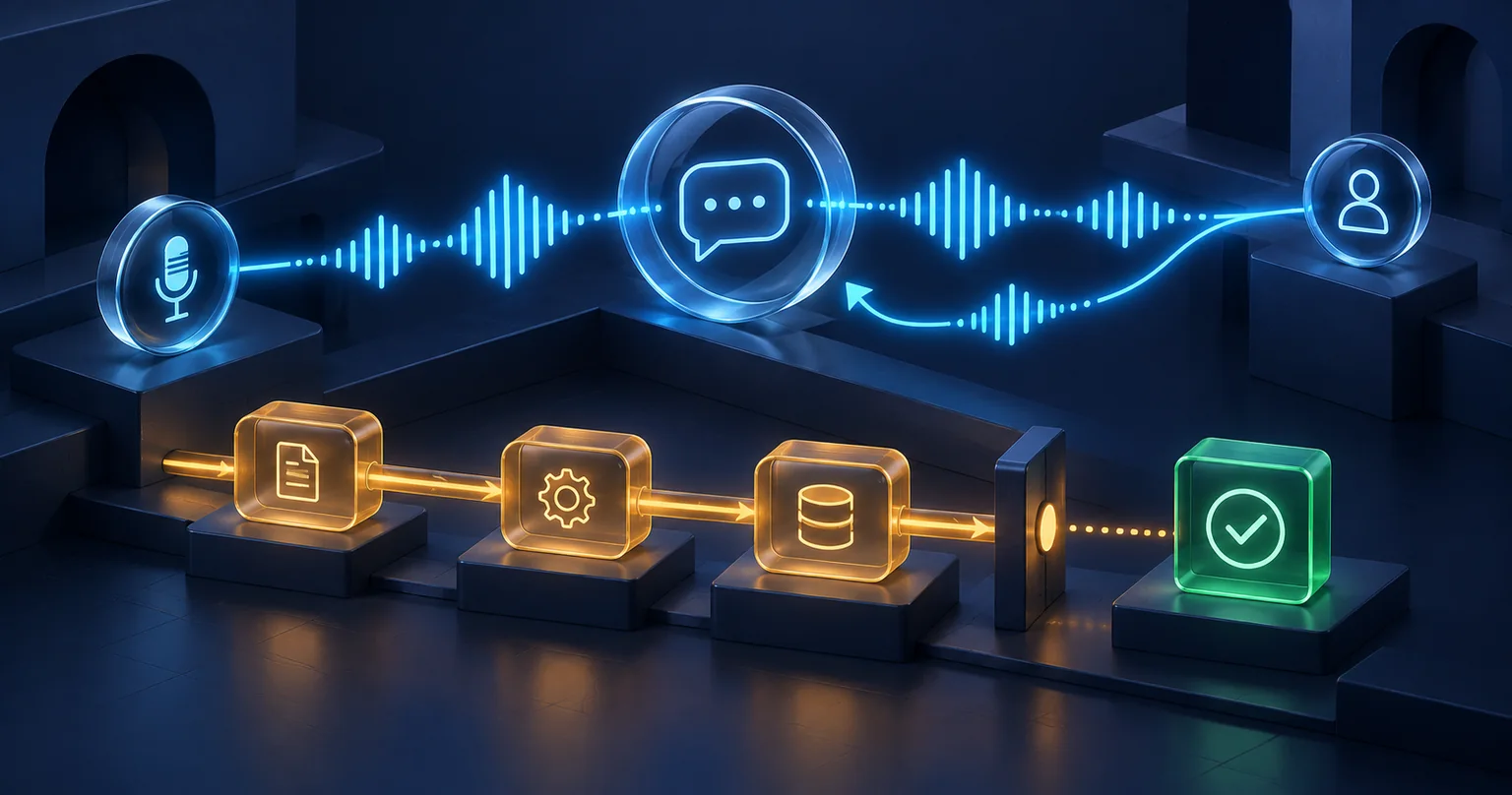
A voice agent can answer immediately and still mishandle an operation. While it checks availability, the user changes the date; while it confirms a request, an earlier query returns. For product and engineering teams, the important decision is how to coordinate a changing conversation with a business system that takes time to respond. Fluid speech makes this problem more visible: a convincing sentence can sound like confirmation of something that has not happened.
On September 15, 2026, Google announced Gemini 3.8 Live and Gemini 3.8 Live Extended Thinking, with rollout beginning that day. It describes models that keep a conversation going while running tools in the background; Extended Thinking adds reasoning for complex requests. That capability makes new voice experiences worth evaluating, but it does not guarantee that your application handles cancellation correctly. This article proposes five architecture decisions and a pilot to test them; these are design recommendations, not results measured by Wasyra.
Chapter 02
What changes with asynchronous execution
The developer announcement highlights asynchronous function calling, visual context and incremental content updates. In product terms, spoken responses no longer have to wait for every external operation. Users can keep providing information while a tool works. This creates an opportunity to reduce awkward silences, but it also requires deciding what happens when a result no longer matches the current intent. We assume no specific latency reduction: that would need to be measured in the actual workflow.
The Live API tools guide documents client-managed function responses, a NON_BLOCKING declaration and policies for communicating results immediately, when idle or silently. These control the conversation, not a transaction in the business system. The page consulted still mixes newer examples with an older model table: verify compatibility with the chosen model and SDK in a minimal test before making those identifiers a production dependency.
Chapter 03
1. Separate conversation state from operation state
Design two related records. The first describes what the user wants now: intent, confirmed parameters and version. The second describes external work: operation identifier, state, result and confirmation time. A call can still be pending after the conversation has moved on. Preserve both facts. When a result arrives, compare its intent version with the current one; valid information for an earlier date must not automatically become the answer to the new request.
Use application identifiers that survive reconnection and map each model call to them. Avoid making the spoken history the only source of truth. If a tool returns success, first store the verifiable result and then enable confirmation to the user. If it returns an unknown state, query the source system. The agent can say it is checking; it should not infer success merely because it sent a request.
Chapter 04
2. Define what an interruption means
Interrupting audio, abandoning an intent and cancelling a write are different events. “Wait” can request silence or stop an operation; when ambiguity has meaningful consequences, clarify before proceeding. Stop playback that no longer fits, mark the intent as awaiting clarification and preserve the actual work state. Do not present the assistant becoming silent as evidence that an external action was cancelled.
Define a cancellation boundary for each tool. A search can be discarded; an accepted modification may require a compensating action, if the system allows one. Once the operation crosses that boundary, explain its state without promising to undo it. For late results, decide whether to discard them, record them or show them as earlier information. That policy should live in the application coordinator and be testable, rather than depending only on narrative instructions to the model.
Chapter 05
3. Separate lookup, proposal and confirmation
Allow low-risk lookups with limited permissions and reserve explicit confirmation for meaningful changes. Present the proposal with the details that affect the decision and bind acceptance to that specific version. If the user changes a parameter, invalidate the earlier proposal. Check authorization on the server using session identity; hearing a familiar voice or receiving a name does not replace an authenticated identity.
For writes, use an idempotency key tied to the business operation when the service supports it. A retry after a lost connection should not create another request. If the service lacks that guarantee, design reconciliation before allowing automatic retries. Also limit concurrent tools and their maximum duration: keeping the conversation going does not make an unbounded queue inexpensive. These controls belong to your integration.
Chapter 06
Hypothetical example: rescheduling a service visit
Imagine an assistant coordinating service visits. The customer asks for Friday morning and switches to Monday while availability is being checked. The coordinator increments the intent version and starts the new lookup. If Friday returns later, it retains that result as stale. The assistant can acknowledge the change and keep listening, but it will only offer Monday slots. No reservation has been written yet.
The customer selects a slot and accepts the current proposal. The server validates permissions, records one operation and requests the change. If audio disconnects afterward, reconnection checks that same operation. If the user says “cancel” after the change has already been confirmed, the assistant explains what happened and offers the available procedure. This case illustrates a proposed policy, not a model demonstration or an actual Wasyra customer implementation.
Chapter 07
4. Measure time to the correct result
Separate three clocks: first audible response, tool result and correct task confirmation. A quick greeting can improve perception without accelerating the work. Also record false confirmations, duplicate writes, use of stale results and human handoffs. When comparing configurations of the same workflow, keep tools, permissions and cases constant. Repeat tests and inspect distributions; a favorable average can hide long waits in the most difficult cases.
Build a test set covering noise, language changes, alphanumeric codes, interruptions before and after a write, slow tools, out-of-order responses and disconnections. Include attempts to change parameters through visual content or retrieved text without user authorization. Decide in advance which failure blocks the pilot: for example, confirming a modification that never happened. That criterion is a team risk decision, not a quality threshold published by Google.
Chapter 08
5. Choose scope before scaling
Start with a workflow that has a clear source of truth and a viable human fallback. Limit audio and images to what is necessary, define retention and trace access, and avoid recording secrets or entire conversations by default. Visual context can help interpret a request, but it does not grant permissions or make a screen trustworthy evidence. For incidents, keep enough structured events to reconstruct what was requested, authorized and done.
Choose between the two announced variants according to your tasks and measurements, not the model name. Evaluate resolution quality, delays, tool use and total cost per completed task, including retries and oversight. Confirm availability in your environment: the announcement distinguishes developer access from enterprise previews. This analysis ran no benchmarks and verified no particular commercial account, and it does not establish that one voice model can replace an entire existing architecture.
Chapter 09
The pilot must demonstrate coordination as well as fluency
Gemini 3.8 Live creates a concrete opportunity: maintaining a useful interaction while the system works. To benefit, the pilot must demonstrate that it distinguishes current intent, pending operation and confirmed result. The five decisions above turn that ambition into observable controls. Expand scope only when the chosen workflow can fail, recover and explain its state without inventing confirmation.
If you are evaluating a voice agent for a specific operation, bring a realistic conversation, its tool contracts and its stopping conditions to the design process. Wasyra’s custom agent service can help define that scope and its acceptance criteria. The next useful deliverable is an evaluable workflow with clear boundaries before committing to broader automation.
Written by
Wasyra AI Systems
Trust, copilots, and enterprise adoption
Wasyra AI Systems covers guardrails, suggestion-first modes, and review design so work assistants earn real adoption.
Series
AI systems that actually reach production
A series on agents, copilots, and guardrails for bringing AI into real work without breaking trust or operations.
Posts in this seriesMore from this author
More from this author
AI Systems
Arcjet agent security: from observation to enforcement
Six criteria for evaluating Arcjet: tool coverage, trusted identity, policies, failures and evidence before granting your agents broader permissions.
ArticleAI Systems
AI agent implementation roadmap: ship agents without breaking operations
Five stages for moving from idea to operable agent: use case, data, permissions, evaluation, deployment, and continuous improvement.
ArticleKeep reading
Keep reading
AI Systems
Arcjet agent security: from observation to enforcement
Six criteria for evaluating Arcjet: tool coverage, trusted identity, policies, failures and evidence before granting your agents broader permissions.
ArticleAI Systems
MCP in production: the protocol standardizing your AI agents in 2026
Model Context Protocol went from experiment to de-facto standard in twelve months. Why Gartner expects 40% of enterprise apps to use it by end of 2026.
ArticleAI Systems
Top 5 AI and product development news to watch now
Five recent moves from OpenAI, GitHub, AWS, and Anthropic that change how teams design, build, and operate software.
Article